
OEM CNC Machined Spline Shaft from China per Drawing
We are a China-based CNC machining workshop focused on custom spline shaft manufacturing. Every CNC machined spline shaft is produced exactly to the customer drawing, CAD model, physical sample or reverse-engineered specification — from a single custom splined shaft prototype to repeat, high-volume spline shaft production runs. We manufacture external spline shafts, internal spline sleeves, involute spline shafts, straight-sided spline shafts, serrated spline shafts, helical spline shafts and integrated spline gear shafts for power transmission, torque transfer and sliding-motion applications worldwide.
As an OEM spline shaft supplier, we combine CNC turning, 4-axis CNC milling, spline hobbing, spline shaping, broaching, cylindrical and centerless grinding, heat treatment and a full range of surface finishes under one controlled process route. Whether you need a hardened and precision ground alloy steel spline drive shaft, a corrosion-resistant stainless steel spline shaft, a brass spline coupling shaft or a lightweight aluminum splined shaft machined from bar stock or a forged blank, the spline profile, journals, shoulders, keyways, threads, cross-holes and end features are all machined as one matched, drawing-compliant assembly feature.
Per Drawing or Sample
PDF, DWG, DXF, STEP, IGES, X_T drawings or physical samples with reverse engineeringBar Stock or Forged
Cold-drawn and hot-rolled round bar, plus open-die and die-forged spline shaft blanksPrecision Machined
Tight-tolerance CNC turning, spline cutting and precision grinding with full inspectionOne Piece to Mass Run
Prototype, small batch, medium batch and stable serial high-volume productionCustom Spline Shaft Types We CNC Machine
Different drive designs call for different spline geometries. Our CNC machined spline shafts cover the full range of common tooth forms, fit classes and shaft layouts, each cut and inspected to the tooth thickness, pitch diameter and fit required on your drawing.
Involute Spline Shaft
The most widely used CNC machined spline shaft profile, with involute flanks that self-center under load and distribute torque across many teeth. Hobbing or shaping produces high-load involute splines for gearboxes, reducers, axles and drive lines in sliding, close or fixed fits.
Straight-Sided Spline Shaft
Also called parallel-key or rectangular spline shafts, with flat, parallel tooth flanks that are straightforward to machine, gauge and assemble. Common for sliding spline connections, telescoping shafts and equipment that needs predictable axial movement.
Serrated Spline Shaft
Fine-pitch triangular serration teeth transmit torque in a compact diameter. CNC milled or hobbed serrated spline shafts are widely used in steering columns, control linkages, small gear motors, hand tools and compact coupling connections.
External and Internal Splines
We machine male external spline shafts and matching female internal spline sleeves, bushings and hubs as matched sets. Tooth thickness, space width and fit class are coordinated so the splined shaft and splined bore assemble with exactly the specified backlash or sliding clearance.
Helical Spline Shaft
Helical spline teeth engage progressively for smoother torque transfer, lower noise and better performance at high rotational speed. CNC machined helical spline shafts suit high-speed gearboxes, servo drives, machine tool transmissions and premium power-train systems.
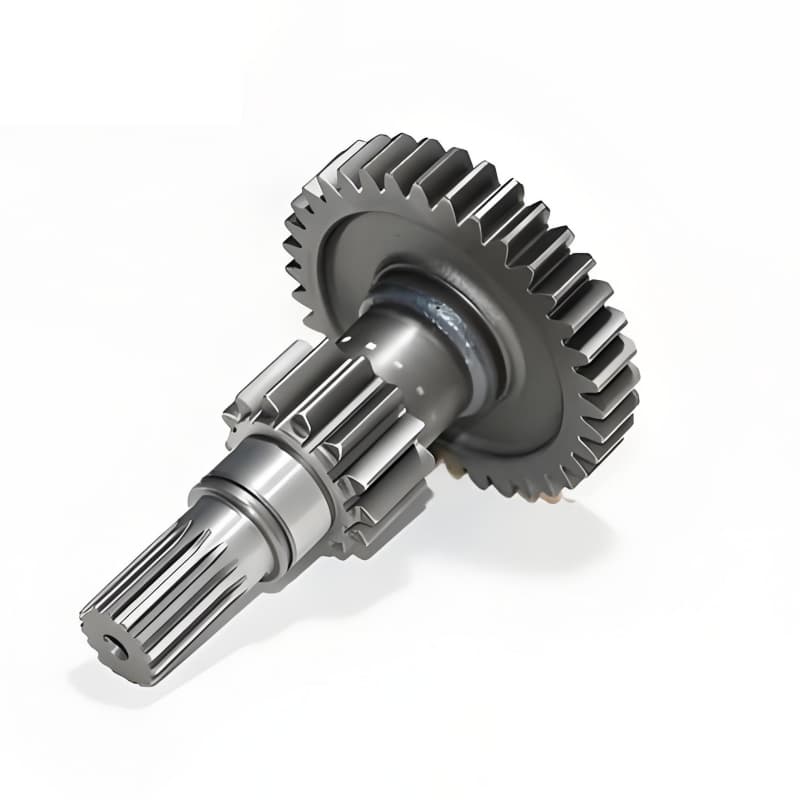
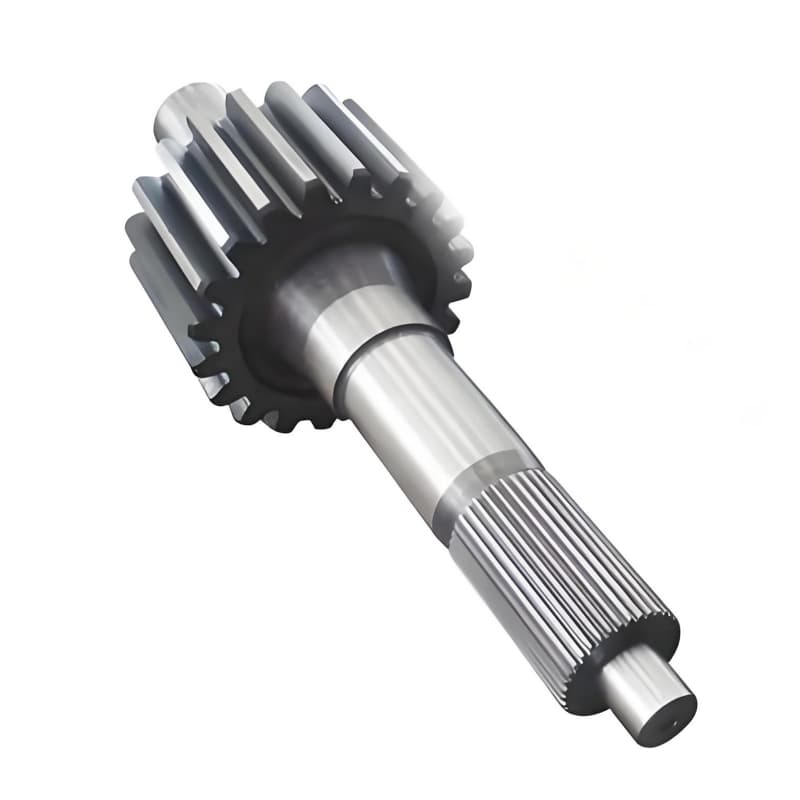
Spline Gear Shaft
An integrated transmission shaft that combines gear teeth, spline sections, bearing journals and shoulders on one blank. The one-setup machining of gear-and-spline shafts protects coaxiality, pitch runout and gear-meshing accuracy in compact gearbox layouts.
Common Materials for CNC Machined Spline Shafts
Material is selected around transmitted torque, sliding wear, corrosion environment, heat treatment and target hardness. The list below covers the grades most often specified on spline shaft drawings; equivalent DIN, JIS, AISI and GB grades can be substituted per drawing approval.
Carbon Steel
1045 / C45, S45C, 40# and 1040 round bar offer good machinability and balanced strength for general-purpose CNC machined spline shafts, output shafts and drive spindles; journals and teeth can be induction hardened for wear resistance.
Alloy Steel
4140 / 42CrMo, 4340 / 40CrNiMo and 40Cr deliver high toughness and torque capacity after quenching and tempering, the standard choice for hardened, precision ground heavy-duty spline drive shafts and gearbox input shafts.
Carburizing Steel
20CrMnTi, 20CrMo, 20Cr and 8620 are carburized, quenched and tempered to create a hard wear-resistant spline tooth case over a tough core — ideal for high-cycle transmission spline gear shafts and axle shafts.
Austenitic Stainless
304, 304L, 316 and 316L stainless steel spline shafts resist corrosion in food, packaging, chemical, marine and wash-down environments, with passivation or electropolishing available for clean-environment use.
Hardened Stainless
17-4 PH / 630, 410, 420 and 431 martensitic and precipitation-hardening stainless grades combine corrosion resistance with high strength and hardness for demanding stainless spline shafts and precision splined spindles.
Bearing & Tool Steel
GCr15 / 52100 bearing steel and selected tool steels reach high hardness and excellent wear resistance, suiting precision splined spindle shafts, indexing shafts and long-life sliding spline connections.
Brass, Bronze & Copper
C36000 free-cutting brass, HPb59-1 leaded brass, tin bronze (CuSn) and copper machine to a fine finish with natural corrosion resistance — used for spline nuts, adjusting spline sleeves and decorative or conductive splined parts.
Aluminum & Light Alloys
6061, 7075 and 2024 aluminum spline shafts are lightweight CNC machined parts for robotics, automation, aerospace fixtures and servo equipment. Titanium and engineering plastics such as POM and PA are also machined on request.
Heat Treatment and Surface Treatment for Splined Shafts
Surface engineering protects spline teeth against wear, corrosion and fatigue while keeping the core tough. Treatments are sequenced around machining and grinding so tooth geometry stays accurate after treatment; multiple finishes can be combined on one CNC machined spline shaft.
Black Oxide
Hot alkaline blackening (black oxide) gives alloy and carbon steel spline shafts an economical, dimension-neutral dark finish with light oil corrosion protection, preserving fine spline tolerances.
Zinc Plating
Clear, blue, colored or yellow zinc plating provides sacrificial corrosion protection for steel spline shafts, splined coupling shafts and PTO shafts used in outdoor and automotive environments.
Nickel Plating
Electroless nickel and electro nickel plating deposit a uniform, wear-resistant layer even over spline tooth flanks and recesses, improving corrosion and abrasion resistance with controlled build-up.
Hard Chrome Plating
Hard chromium coating on bearing journals and spline surfaces raises surface hardness and wear life; plated journals are finish-ground to restore diameter and runout accuracy.
Carburizing & Quenching
Case carburizing followed by quenching and tempering creates a hard HRC 58–62 tooth case with a tough core, followed by post-treatment grinding of precision spline shafts.
Induction Hardening
Selective high-frequency or flame induction hardening targets spline teeth and bearing journals, delivering localized wear resistance while protecting the rest of the shaft from distortion.
Nitriding & QPQ
Gas nitriding, plasma nitriding and QPQ salt-bath nitriding produce a hard, low-distortion surface layer — excellent for finished, precision ground spline shafts that cannot tolerate post-treatment distortion.
Other Finishes
Phosphating, stainless passivation, mirror or belt polishing, aluminum anodizing, sandblasting and precision tumbling/deburring are available to match drawing appearance and protection requirements.
Related Machined Shaft and Spline Products
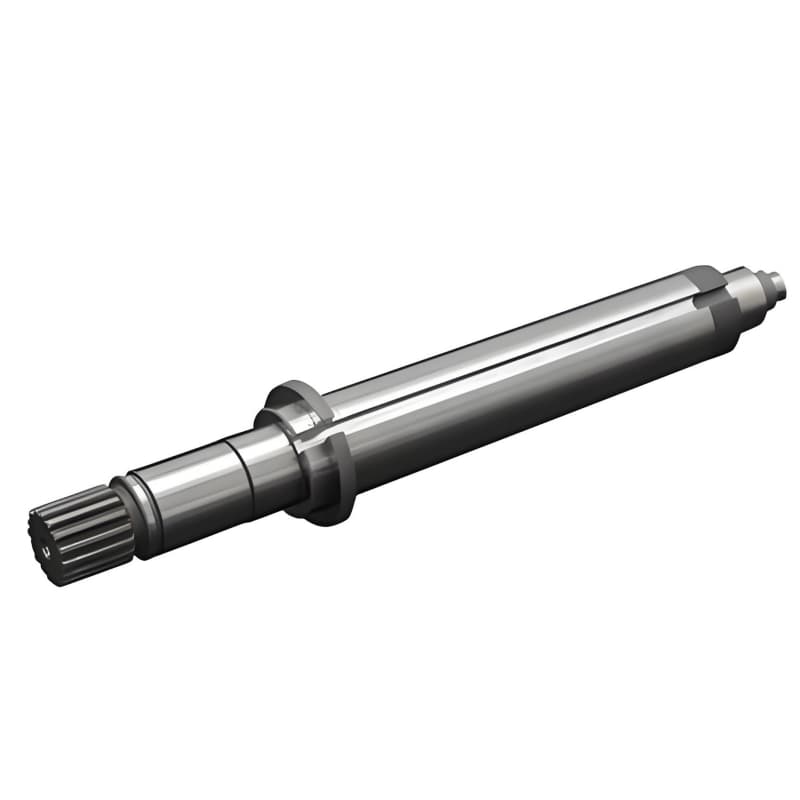
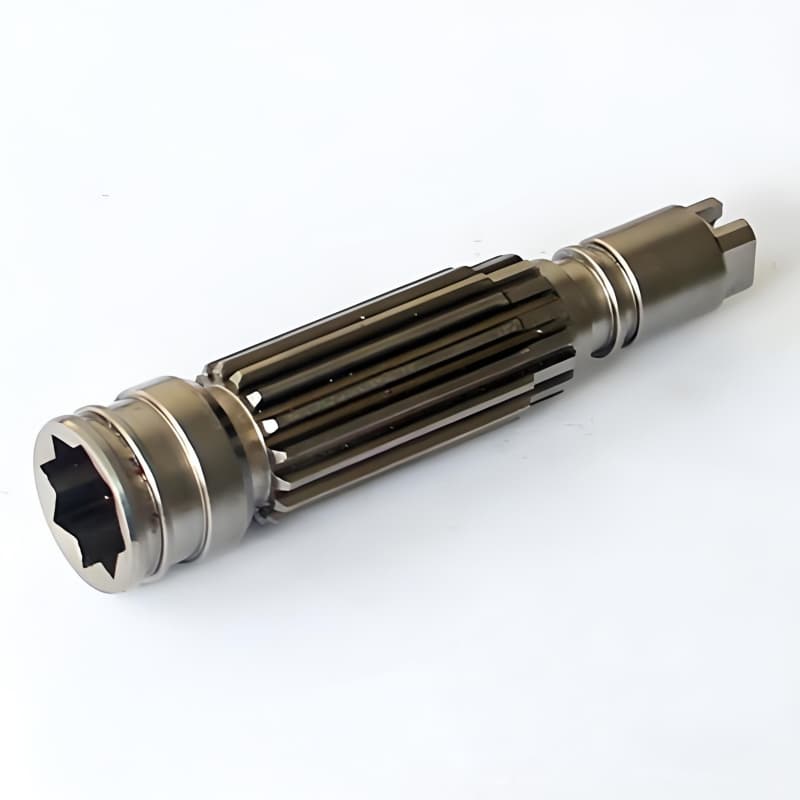
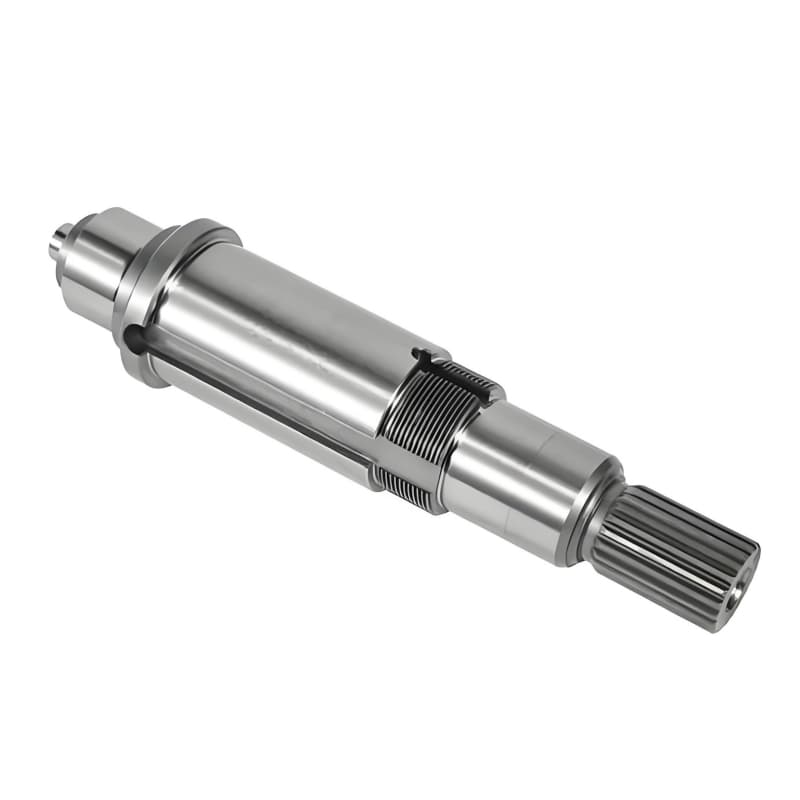
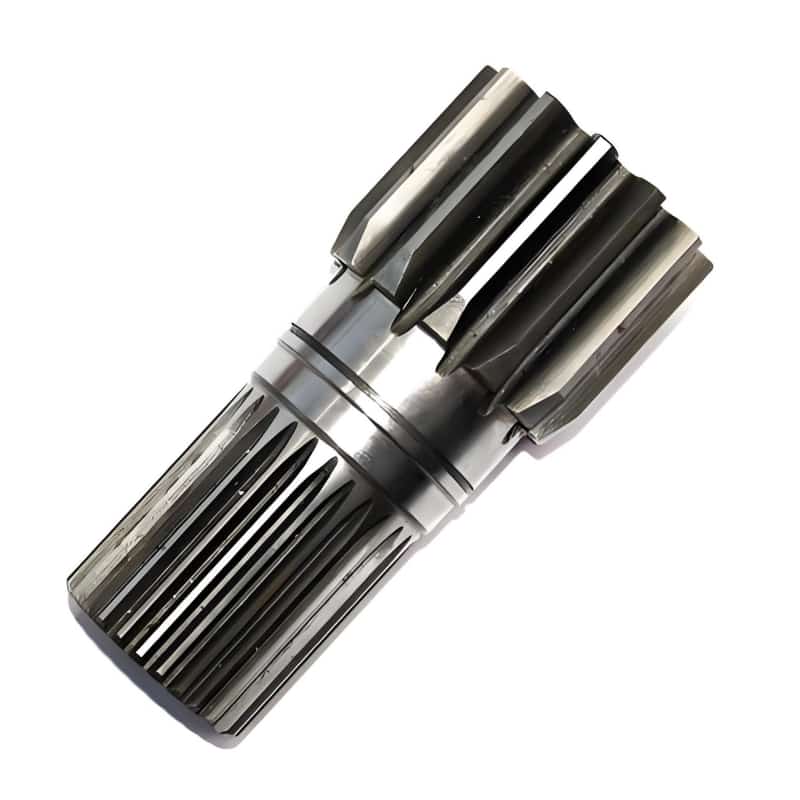
Alongside custom spline shafts, we CNC machine a full family of precision shafts, gear shafts and splined transmission parts from the same drawing-driven process.
Bar Stock and Forged Blank Machining Routes
The right starting stock defines strength, lead time and cost. We evaluate shaft size, torque level and batch quantity when choosing between machined bar stock and a forged spline shaft blank, then plan every machining, heat-treatment and finishing step in the correct sequence.
Bar Stock Machining
Cold-drawn or hot-rolled round bar is saw-cut, CNC turned and spline-cut directly — the fastest, most economical route for small and medium diameter CNC machined spline shafts with short lead times.
Forged Blank Machining
Open-die forgings or die-forged blanks are used for large, high-load spline shafts. Forging refines grain flow along the shaft axis, raising fatigue strength and impact toughness for heavy drivetrain parts.
Heat Treatment Sequencing
Annealing, normalizing, quenching and tempering, carburizing, induction hardening, nitriding and stress-relief straightening are scheduled between rough and finish machining to protect final accuracy.
Integrated Operations
CNC turning, 4-axis milling, hobbing, shaping, broaching, keyway milling, thread cutting, drilling, cylindrical grinding and centerless grinding run in one coordinated routing for a finished spline shaft.
Achievable Dimensional Accuracy and Surface Quality
Precision is built through rough machining, heat treatment and finish grinding rather than a single operation. The capabilities below reflect typical CNC machined and ground spline shaft work; tighter values can be quoted against the specific datum structure and spline class on your drawing.
Dimensional Tolerance
CNC turned journals hold IT7–IT8; finish-ground bearing seats and sealing diameters reach IT6–IT5, with diameter control down to ±0.005 mm on critical precision spline shaft journals.
Spline Tooth Accuracy
Pitch error, accumulated pitch error, profile error and lead error are controlled to the spline fit class on the drawing; tooth thickness and space width are verified with spline ring and plug gauges.
Surface Roughness
Turned surfaces reach Ra 1.6–3.2; fine turning reaches Ra 0.8; ground journals and spline flanks reach Ra 0.2–0.4; polished stainless spline shafts can be finished to an even finer, near-mirror surface.
Concentricity & Runout
Circular runout and coaxiality between the spline pitch circle, bearing journals and seal seats are typically held to 0.01–0.02 mm by grinding between centers after heat treatment.
Straightness of Long Shafts
Long spline shafts are stress-relieved and straightened after hardening, then centerless or cylindrically ground to control bend, taper and cylindricity over the full shaft length.
Hardness & Case Depth
HRC/HV hardness and effective case depth of carburized, induction-hardened or nitrided spline teeth are measured and recorded, with material and hardness traceability kept by production batch.
| Capability Item | Typical Achievable Range for CNC Machined Spline Shafts |
|---|---|
| Shaft diameter range | From Ø3 mm small spline shafts to Ø300 mm and larger on forged blanks, per drawing |
| Shaft length range | Short coupling spline shafts up to long spline shafts of 1500 mm and beyond |
| Turned diameter tolerance | IT7–IT8 standard; IT6 on fine CNC turning with controlled tooling and temperature |
| Ground diameter tolerance | IT5–IT6, with critical journals controlled to ±0.005 mm or tighter |
| Surface roughness | Ra 1.6–3.2 turned; Ra 0.8 fine turned; Ra 0.2–0.4 ground; finer by polishing |
| Runout / coaxiality | 0.01–0.02 mm between spline pitch diameter and ground bearing datums |
| Tooth surface hardness | Up to HRC 58–62 case hardness for carburized or induction-hardened splines |
Spline Shaft Machining and Inspection Capabilities
Every custom spline shaft flows through controlled metal-cutting and independent dimensional verification, so tooth geometry, journal accuracy and surface quality are confirmed before delivery rather than assumed.
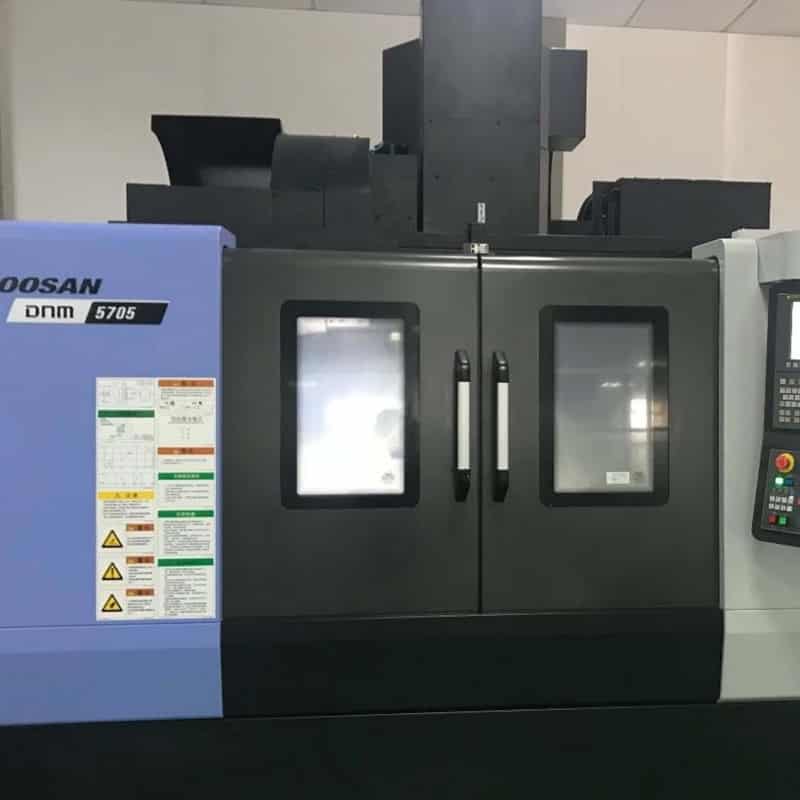
CNC Milling
4-axis CNC milling cuts spline profiles, helical teeth, keyways, wrench flats, cross-holes and custom end features when hobbing is not suitable, especially for prototype and low-volume spline shafts.
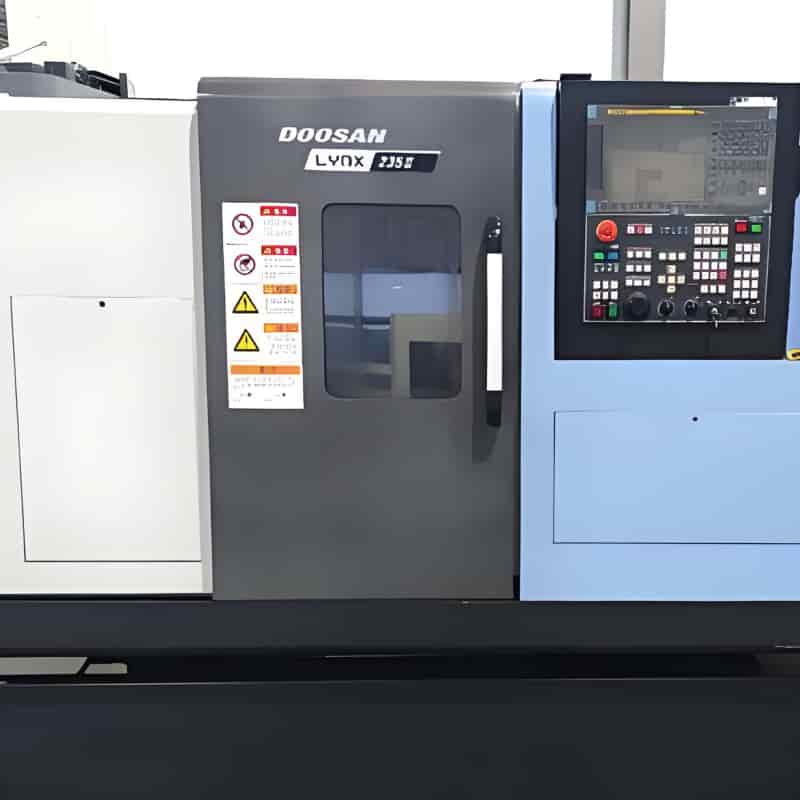
CNC Turning
CNC lathes turn stepped journals, shoulders, grooves, chamfers, threads and the pre-spline blank from bar or forged stock, establishing concentric datums for all later spline cutting and grinding.
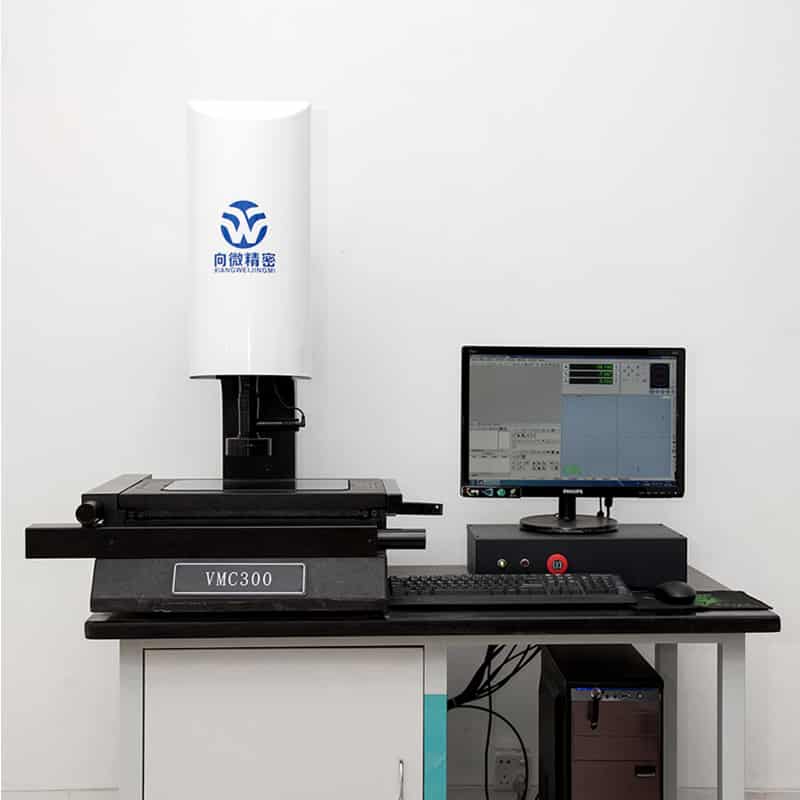
2D Projector Measuring
An optical profile projector magnifies spline tooth outlines, pressure angles, radii and chamfers for direct comparison with the drawing, catching small-feature errors that calipers cannot resolve.
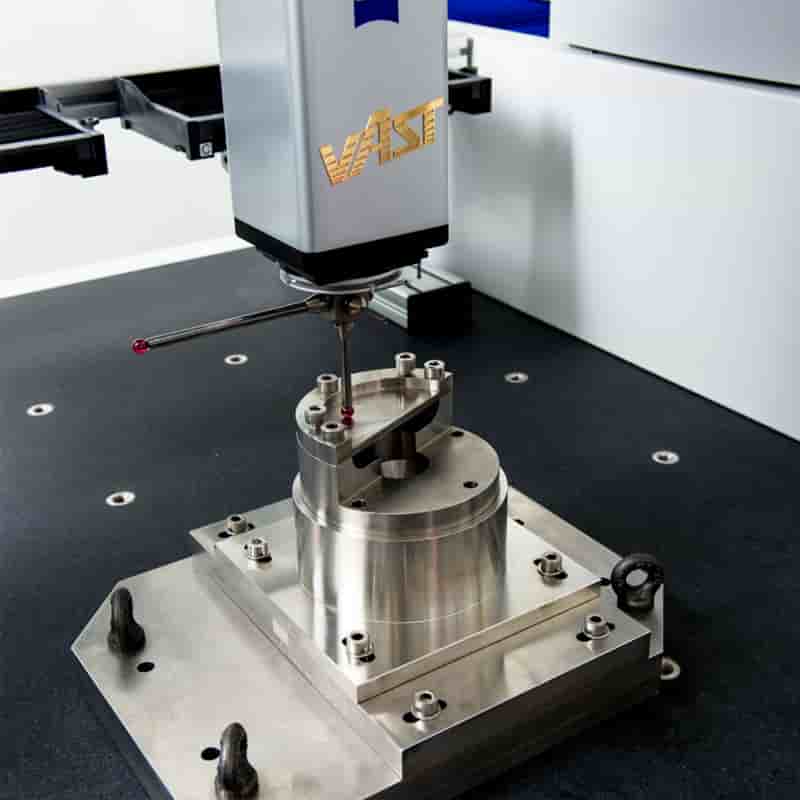
CMM Testing
A coordinate measuring machine verifies diameters, hole positions, runout and datum relationships; micrometers, bore gauges, height gauges, roughness testers, hardness testers and spline gauges complete first-article and batch inspection.
Industries and Applications of Custom Spline Shafts
CNC machined spline shafts appear wherever rotating torque must be transmitted while allowing precise mating or axial sliding. The applications below show the range of sectors our custom splined shafts and spline gear shafts serve.
Automotive & Vehicles
Transmission input and output shafts, axle and differential spline shafts, steering column shafts, PTO shafts and gearbox spline gear shafts for cars, trucks, buses and off-highway vehicles.
Agricultural Machinery
Tractor PTO spline shafts, combine harvester drive shafts, seeder, baler and rotary tiller transmission shafts built to withstand dust, shock loads and seasonal heavy-duty cycles.
Construction Equipment
Splined pump and motor shafts, travel-drive and swing-drive shafts for excavators, wheel loaders, forklifts, skid steers and concrete and lifting machinery.
Mining & Heavy Industry
Heavy-duty splined drive shafts for conveyors, crushers, winches, steel mills and crane travel mechanisms, often machined from forged alloy steel blanks and hardened for long life.
Gearboxes & Power Transmission
Spline shafts, spline coupling shafts and gear motor shafts for industrial reducers, speed increasers, pump drives and general power-transmission equipment requiring matched spline fits.
Marine & Renewable Energy
Corrosion-resistant stainless and coated spline shafts for deck machinery, propeller and rudder systems, plus wind turbine pitch and yaw drive spline shafts and tidal-energy mechanisms.
Robotics & Machine Tools
Precision ball spline shafts, linear motion spline shafts, servo drive shafts and spindle shafts for automation lines, robots, actuators, CNC machine tools and packaging automation.
Food, Medical & Light Industry
Stainless steel spline shafts for food processing, packaging, medical equipment, textile and printing machinery, where smooth surfaces, passivation and clean operation are required.
From One Prototype to High-Volume Production
Batch size never limits the engineering attention a spline shaft receives. The same drawing review, machining standards and inspection discipline apply to a single replacement spline shaft and to a recurring serial order of tens of thousands.
Prototype / Single Piece
One-off CNC machined spline shafts and small runs of 1–10 pieces for maintenance replacement, equipment repair, design verification and sample-based reverse engineering, with no rigid minimum order barrier.
Small Batch
Pilot runs for new product introduction, fixture and fit validation and field testing; tooling and process parameters are refined before scaling so serial production starts from a stable baseline.
Medium Batch
Repeat batches for assembly lines and aftermarket supply, produced with standardized routings, dedicated gauges and batch-level material, hardness and dimensional traceability.
High-Volume / Serial Run
Stable mass production with optimized cycle times, consistent spline accuracy batch after batch, planned repeat-order scheduling and statistical process control on critical dimensions.
How a Custom Spline Shaft Is Built per Drawing or Sample
A controlled, step-by-step process turns a drawing or worn sample into a repeatable, inspection-backed CNC machined spline shaft — with manufacturability feedback raised early, before metal is cut.
Drawing or Sample Review
Drawings, 3D models or physical samples are reviewed for spline geometry, datums, tolerances, material and hardness; DFM feedback and clarification are provided before production.
Material & Stock Route
The correct grade is selected and sourced as bar stock or forged blank, with chemistry and condition matched to the required heat treatment and torque load.
Process & Tooling Planning
Machining allowances, grinding stock, spline-cutting method, workholding and inspection gauges are planned so heat-treatment distortion is fully compensated.
CNC Turning of Blank
Sawing and CNC turning establish all stepped diameters, shoulders, grooves, chamfers, threads and center holes, creating the concentric datums for later operations.
Spline Cutting
Involute, straight-sided or serrated splines are hobbed, shaped, broached or 4-axis CNC milled, with internal spline sleeves machined to match the external shaft.
Heat Treatment & Straightening
Carburizing, quenching and tempering, induction hardening or nitriding is followed by stress-relief straightening to lock in hardness without losing geometry.
Grinding & Surface Finish
Cylindrical and centerless grinding restore journal accuracy and surface roughness, followed by plating, black oxide, passivation, polishing or other specified finishes.
Inspection & Packaging
CMM, 2D projector, spline gauges, micrometers, hardness and roughness checks confirm the part against the drawing before protected, corrosion-inhibited packaging and dispatch.
Your OEM Partner for Custom CNC Machined Spline Shafts in China
When your equipment needs more than a catalog spline shaft, we manufacture the exact part your design requires: CNC machined involute spline shafts, hardened and ground spline drive shafts, stainless steel spline shafts, alloy steel transmission spline shafts, brass spline coupling shafts, aluminum lightweight spline shafts, hollow spline shafts, long spline shafts, stepped spline shafts and integrated spline gear shafts with keyways, threads, cross-holes, retaining-ring grooves and custom mounting features machined in the same setup. Sliding spline shafts, fixed spline connections and matched external-and-internal spline sets are produced with controlled backlash, smooth axial motion and reliable torque transmission over long service life.
Send a drawing for a quotation-ready review, or send a worn or broken sample and we will reverse-engineer an equivalent CNC machined spline shaft from measured tooth form and fitted dimensions. From a single maintenance replacement splined shaft to ongoing high-volume OEM programs, from soft untreated bar-stock shafts to carburized, nitrided and precision ground heavy-duty forged spline shafts, every order is machined to the drawing, verified by independent inspection and built to perform in gearboxes, drivetrains, pumps, motors, actuators and machinery across automotive, agriculture, construction, mining, marine, energy, automation and general industrial markets.