
Custom precision CNC machining aluminum 6061 parts in China
Custom precision CNC machining aluminum 6061 parts in China is a proven sourcing route for engineers and procurement teams that need strong, lightweight and corrosion-resistant components at competitive cost. Aluminum alloy 6061 combines excellent machinability, dimensional stability and compatibility with almost every industrial surface finish, which is why it appears in everything from aerospace brackets and automotive housings to semiconductor fixtures and robotic end-effectors. When you order custom CNC machining aluminum 6061 parts in China, you gain access to 3-axis, 4-axis and 5-axis machine tools, tight tolerance control and flexible batch sizes ranging from single prototypes to full production runs.
Why aluminum 6061 is a preferred choice for CNC machining
Aluminum 6061 is one of the most widely machined alloys in the world. The six characteristics below explain why it is the default material for custom CNC machining aluminum 6061 parts in China across demanding industries.
High strength-to-weight ratio
Aluminum 6061 delivers a tensile strength of up to 310 MPa (45 ksi) and a yield strength of up to 276 MPa (40 ksi) in the T6 condition, while density stays at just 2.70 g/cm³. This combination lets designers replace heavier steel components without sacrificing structural performance, which is critical in aerospace, automotive and robotics.
Reliable machinability
The alloy forms short, controlled chips, causes low tool wear and holds tight tolerances over long production runs. This translates directly into faster cycle times and lower unit cost for custom CNC machining aluminum 6061 parts in China.
Strong corrosion resistance
A stable natural oxide layer protects 6061 against atmospheric corrosion, salt water and many industrial chemicals. Components machined from 6061 are widely used in marine hardware and outdoor equipment, often with little or no protective coating.
Excellent anodizing compatibility
6061 responds consistently to Type II color anodizing and Type III hard-coat anodizing. Anodized surfaces provide wear resistance, corrosion protection and the professional clear or black appearance requested on most engineering drawings.
Good weldability and formability
The alloy can be welded with standard filler metal and formed before or after heat treatment. This flexibility simplifies assemblies that combine machined blanks with welded structures and reduces the number of separate parts in a product.
Dimensional stability
Stress-relieved tempers such as T651 keep internal residual stress low, so precision-machined thin walls, slots and mounting surfaces hold their geometry after the part is released from the machine. The result is reliable fit and repeatability in every batch, making it a dependable choice for custom CNC machining aluminum 6061 parts in China.
Aluminum 6061 grade designations under different national standards
The same alloy is listed under different commercial designations depending on the national or regional standard used on the drawing. All designations below refer to the same aluminum-magnesium-silicon alloy family with equivalent chemical composition limits, so a part drawn to any of these grades can be manufactured as custom CNC machining aluminum 6061 parts in China.
| Country / region | Governing standard | Commercial designation | Note |
|---|---|---|---|
| United States | AA (Aluminum Association) & ASTM B221 | 6061 (UNS A96061) | The most widely referenced designation in international trade and engineering drawings. |
| China | GB/T 3190 | 6061 | Widely used in domestic Chinese manufacturing; composition matches the AA 6061 family. |
| Europe | EN 573-3 / EN 485-2 | EN AW-6061 | The official European designation for the same alloy. |
| Germany | DIN 1725-1 (legacy) | AlMg1SiCu | Legacy designation still found on older German drawings and specifications. |
| Japan | JIS H4000 | A6061 | Common designation in Japanese and Asian supply chains. |
| United Kingdom | BS 1474 / BS 1470 (legacy) | HE30 | Legacy British designation for 6061 plate, bar and sections. |
| International | ISO 209 | AlMg1SiCu | Chemical-composition-based designation used in international trade. |
For sourcing purposes, a drawing marked EN AW-6061, A6061 or HE30 can all be quoted and machined as custom CNC machining aluminum 6061 parts in China. Confirm the required temper (for example T6 or T651) and the surface finish separately, because neither is part of the grade designation.
Chemical composition and mechanical properties of 6061
The table on the left shows the nominal composition limits of aluminum 6061; the table on the right lists the typical mechanical and physical properties in the T6/T651 condition, which is the temper most often specified for custom CNC machining aluminum 6061 parts in China.
| Element | Composition limit (%) |
|---|---|
| Silicon (Si) | 0.40 – 0.80 |
| Iron (Fe) | ≤ 0.70 |
| Copper (Cu) | 0.15 – 0.40 |
| Manganese (Mn) | ≤ 0.15 |
| Magnesium (Mg) | 0.80 – 1.20 |
| Chromium (Cr) | 0.04 – 0.35 |
| Zinc (Zn) | ≤ 0.25 |
| Titanium (Ti) | ≤ 0.15 |
| Others, each / total | ≤ 0.05 / ≤ 0.15 |
| Aluminum (Al) | Remainder |
| Property | Typical value (T6/T651) |
|---|---|
| Density | 2.70 g/cm³ |
| Tensile strength | up to 310 MPa (45 ksi) |
| Yield strength | up to 276 MPa (40 ksi) |
| Elongation in 50 mm | 12 – 17 % |
| Hardness | approx. 95 HB |
| Modulus of elasticity | 68.9 GPa (10,000 ksi) |
| Melting range | 582 – 652 °C |
| Thermal conductivity | approx. 167 W/(m·K) |
Values are typical for the T6/T651 condition and may vary slightly with section thickness and supplier practice. Confirm the mechanical requirements with your drawing before quoting.
Aluminum 6061 temper conditions and their selection
The temper letter and number follow the grade (for example 6061-T6) and define the heat treatment state of the material. Selecting the right temper is an important step in the design of custom CNC machining aluminum 6061 parts in China.
O — Annealed
Maximum formability and ductility with the lowest strength. Used when a part must be bent or formed before a later heat treatment step.
T4 — Naturally aged
Solution heat treated and naturally aged. Offers moderate strength with good formability and is less common for finished machined parts.
T6 — Artificially aged
Solution heat treated and artificially aged. The default machining temper for aluminum 6061, delivering the high strength and hardness most drawings specify.
T651 / T6511 — Stress relieved
T651 (plate and bar) and T6511 (extruded bar) add a controlled stretching step that relieves residual stress, giving the best dimensional stability for precision machining.
Industries that rely on custom CNC machining aluminum 6061 parts in China
Aluminum 6061 serves a remarkably broad range of end markets. The six application areas below are where machined 6061 parts are specified most frequently.
Aerospace components
Non-critical structural brackets, hinge fittings, covers and mounting plates benefit from 6061’s strength, low weight and corrosion resistance.
Automotive and EV parts
Battery pack housings, motor brackets, heat sinks and trim components are routinely produced as custom CNC machining aluminum 6061 parts in China.
Marine hardware
Deck fittings, pulley blocks, hatch components and instrument housings withstand salt-water exposure when finished with a suitable anodized or coated surface.
Electronics and semiconductor
Heat sinks, vacuum fixture plates, equipment enclosures and structural frames rely on 6061’s thermal conductivity and dimensional stability.
Robotics and automation
Machine frames, mounting plates, end-effector fixtures and adapter plates are machined to tight tolerances for repeatable assembly and alignment.
Industrial machinery and tooling
Jigs, fixtures, pneumatic components, valve bodies and prototype parts are cost-effective in 6061 with short lead times and easy rework.
Machined aluminum 6061 product examples
The four product types below are commonly produced as custom CNC machining aluminum 6061 parts in China, covering enclosures, covers, structural shells and thermal components.
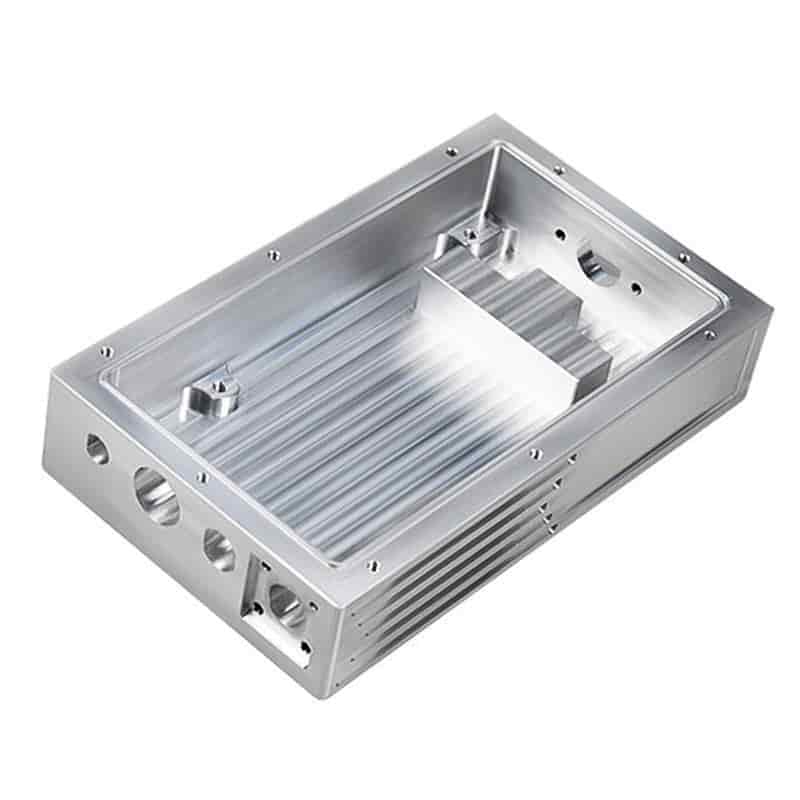
Housing
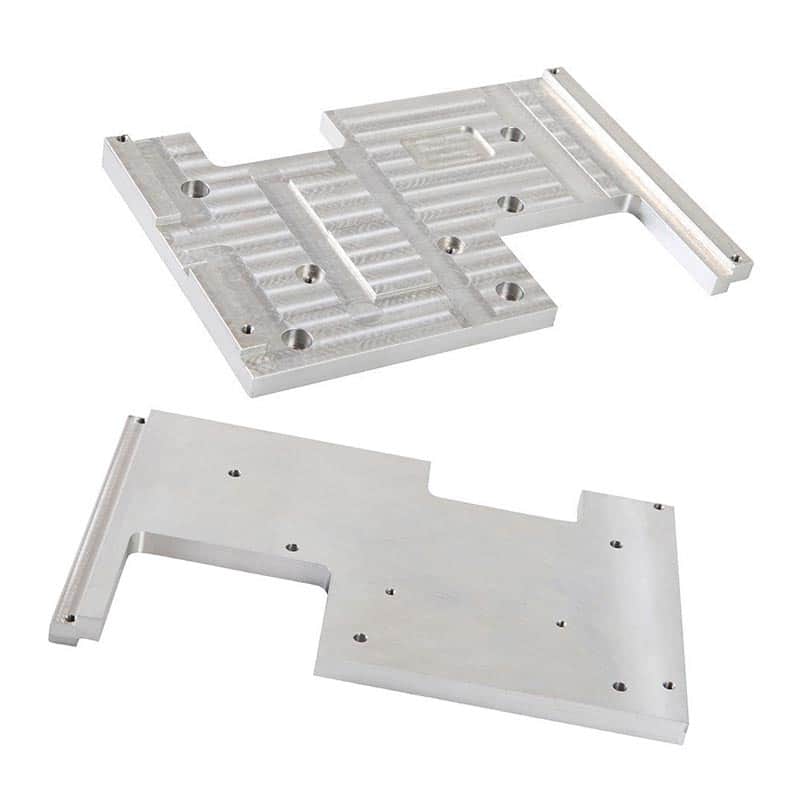
Cover
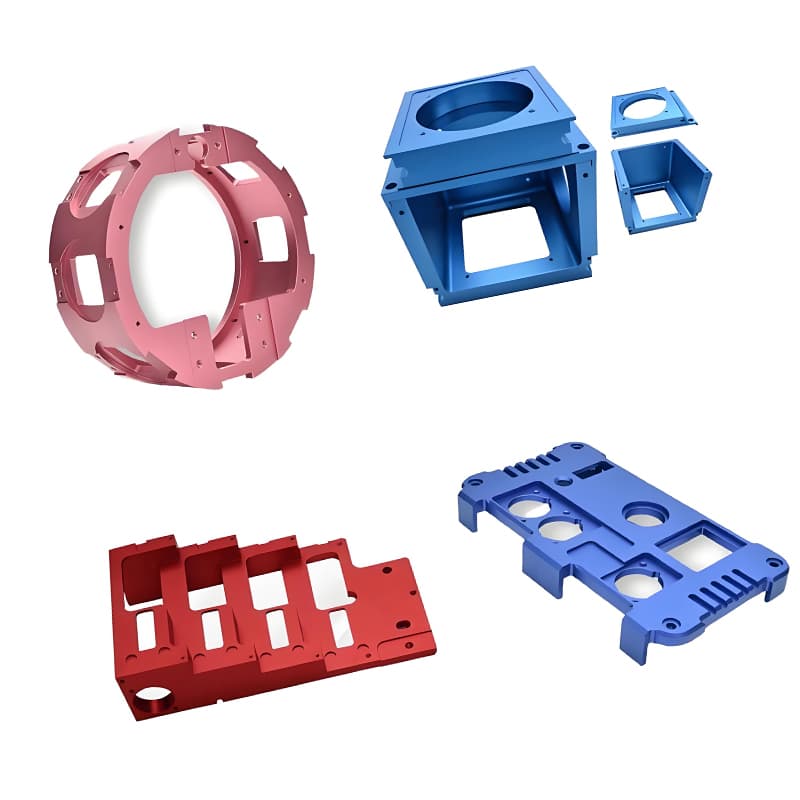
Shell
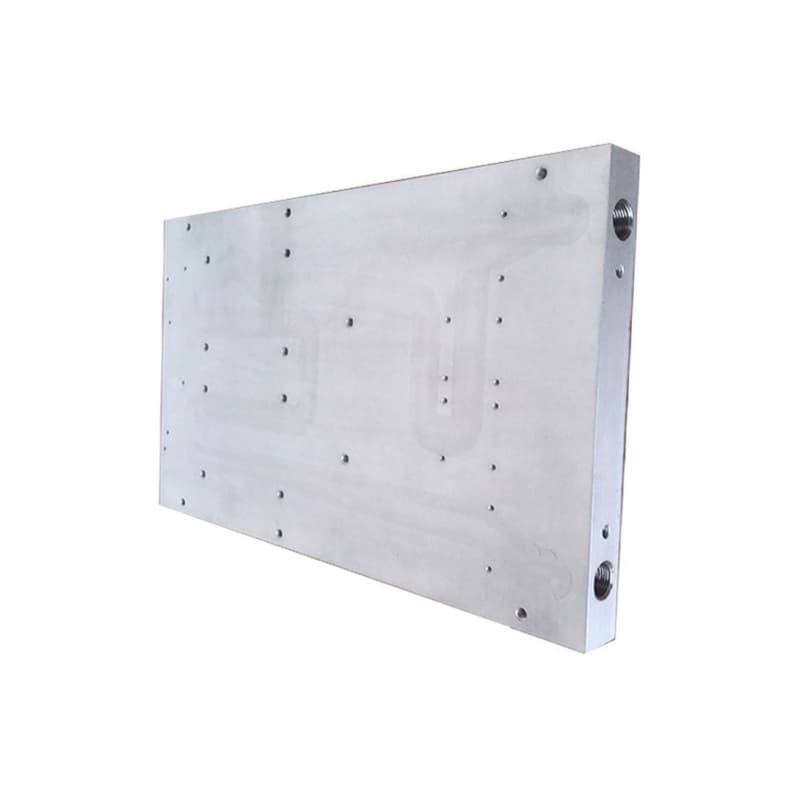
Cooling plate
Surface finishing options for machined aluminum 6061
The right finish protects the part, improves wear resistance and controls the final appearance. The eight finishing routes below cover the most common specifications for custom CNC machining aluminum 6061 parts in China.
Clear anodizing
A transparent anodic layer (Type II) that preserves the natural aluminum look while improving wear and corrosion resistance.
Black anodizing
The most requested cosmetic finish for custom CNC machining aluminum 6061 parts in China; gives a deep, even black for optics, electronics and mechanical parts.
Hard anodizing
A thick, dense anodic layer (Type III, 25–75 µm) for high wear resistance on sliding surfaces and threaded features.
Bead blasting
A uniform matte texture applied before anodizing or painting to hide machining marks and give a consistent satin appearance.
Powder coating
A durable, decorative color coating in RAL or custom colors, ideal for larger housings and frames exposed to weather.
Polishing
Mechanical polishing to a bright, reflective surface for decorative components and visible trim pieces.
Chem film conversion
A thin protective conversion coating used on interior components and as an adhesion primer for subsequent finishes.
Laser marking
Permanent logos, part numbers and inspection marks applied without damaging the machined surface.
CNC machining capabilities for aluminum 6061
The manufacturing capability of a shop determines what can actually be achieved on your drawing. The table below summarizes the working envelope and typical process limits for custom CNC machining aluminum 6061 parts in China.
| Capability | What can be achieved |
|---|---|
| Machine tools | 3-axis, 4-axis and 5-axis CNC milling centers plus CNC lathes, allowing turned and milled features to be produced in one setup. |
| Workpiece envelope | Parts up to approximately 800 × 600 × 400 mm can be machined; larger sizes are reviewed case by case. |
| Tolerance control | Standard tolerances of ±0.05 mm; precision features held to ±0.01 mm or better depending on part geometry. |
| Surface roughness | Ra 0.4 – 3.2 µm achievable across machined faces, bores and pockets. |
| Threads and features | Tapped holes, milled threads, slots, pockets and press-fit features produced directly in 6061. |
| Batch sizes | From single prototype pieces to low and medium volume production with repeatable quality on every lot. |
Quality control and inspection of machined 6061 parts
Dimensional accuracy is verified through a structured inspection flow rather than a single final check. The four stages below describe how quality is controlled during the production of custom CNC machining aluminum 6061 parts in China.
Incoming material inspection
Alloy condition and incoming bar or plate dimensions are verified before machining, keeping material batches clearly identified and separated.
In-process inspection
Operators check critical dimensions with calipers, micrometers and go/no-go gauges at defined machining stages, catching deviations before they propagate.
Final dimensional inspection
Finished parts are measured against the drawing with calibrated instruments, including CMM measurement for complex profiles and true position requirements.
Surface and packaging verification
Surface finish, edge condition and cosmetic requirements are confirmed, then parts are cleaned and protected for safe shipment.
Sourcing custom CNC machining aluminum 6061 parts in China
What you can expect
From a single prototype to repeatable production, custom CNC machining aluminum 6061 parts in China delivers precise geometry, dependable material quality and cost-effective lead times. With the drawing specifying tolerances, temper and finish, parts are machined, inspected and prepared exactly to your specification.
Why this material stays popular
For design and engineering teams evaluating suppliers, custom CNC machining aluminum 6061 parts in China remains one of the most balanced choices between performance, price and production flexibility. The same alloy, familiar across every national standard, keeps the supply chain simple from drawing to delivery.