
Custom precision CNC machining aluminum a380 parts in China
High-accuracy custom CNC machining aluminum a380 parts in China, engineered for complex geometries, tight tolerances, and volume production for global OEMs and product designers.
From prototype runs to full-scale manufacturing, our CNC machining facilities deliver A380 aluminum components with consistent dimensional precision, excellent surface finish, and reliable material performance. A380 is the most widely specified aluminum die-casting alloy in the world, prized for its superior fluidity, good mechanical strength, and exceptional machinability — making it the ideal substrate for precision secondary CNC operations.
Understanding A380 Aluminum Alloy
A380 is an Al-Si-Cu series aluminum alloy defined under ASTM B85 and SAE J452 standards. It is the workhorse of the aluminum die-casting industry, offering an unmatched balance of castability, mechanical properties, and cost efficiency. When combined with precision CNC machining, A380 delivers net-shape components with the fine detail and tight tolerances that modern engineering demands.
Why Engineers Choose A380
The high silicon content (7.5–9.5%) gives A380 exceptional molten-metal fluidity, allowing it to fill intricate die cavities with thin walls down to 1.5 mm. This makes the alloy particularly well suited for complex housings, brackets, and structural components that would be difficult or uneconomical to produce with other aluminum grades.
Copper at 3.0–4.0% contributes solid-solution strengthening and improves hardness and wear resistance. The alloy responds well to secondary CNC machining — chips break cleanly, tool wear is moderate, and fine surface finishes down to Ra 0.8 μm are readily achievable. For custom CNC machining aluminum a380 parts in China, this alloy represents the optimal intersection of manufacturability and performance.
A380 is not typically heat-treatable to high strengths, but its as-cast properties are sufficient for the vast majority of structural and enclosure applications. Where higher strength is required, designers often specify A380 with additional CNC machining to remove porosity zones and expose the denser material beneath the casting skin.
Chemical Composition (ASTM B85, wt%)
| Silicon (Si) | 7.5 – 9.5 |
|---|---|
| Copper (Cu) | 3.0 – 4.0 |
| Iron (Fe) | ≤ 1.3 |
| Zinc (Zn) | ≤ 3.0 |
| Manganese (Mn) | ≤ 0.50 |
| Magnesium (Mg) | ≤ 0.10 |
| Nickel (Ni) | ≤ 0.50 |
| Tin (Sn) | ≤ 0.35 |
| Aluminum (Al) | Balance |
Key Material Properties of A380
The mechanical and physical characteristics of A380 make it a versatile engineering material. Below are the typical as-cast property values that designers reference when specifying custom CNC machining aluminum a380 parts in China.
Tensile Strength
Typical ultimate tensile strength ranges from 310 to 340 MPa in the as-cast condition, with yield strength around 160 MPa. These values provide adequate structural integrity for housings, brackets, and enclosures under normal service loads.
Superior Castability
The high silicon content produces excellent fluidity in the molten state, enabling the production of thin-wall sections (as thin as 1.5 mm) and complex internal geometries. This reduces the need for excessive material removal during CNC finishing.
Excellent Machinability
A380 generates short, broken chips during milling, turning, and drilling operations. Tool wear is moderate compared to pure aluminum, and surface finishes as fine as Ra 0.8 μm are achievable with standard carbide tooling and proper coolant application.
Thermal Conductivity
Thermal conductivity of approximately 96 W/(m·K) at room temperature, making A380 suitable for heat sink housings, electronic enclosures, and thermal management components where heat dissipation is a design requirement.
Dimensional Stability
Low solidification shrinkage (approximately 3.5–4.0%) and good as-cast dimensional repeatability ensure that CNC-machined A380 parts maintain tight tolerances across production batches, with minimal post-machining distortion.
Low Density
Density of approximately 2.71 g/cm³, comparable to other common aluminum alloys. This lightweight characteristic, combined with good specific strength, makes A380 an attractive choice for weight-sensitive automotive and aerospace-adjacent applications.
A380 Equivalent Designations by Standard
A380 is known by different grade names and designations across national and international standards. When sourcing custom CNC machining aluminum a380 parts in China, it is important to understand these cross-references to ensure the correct material is specified and verified.
| Standard / Region | Designation | Full Name / Notes |
|---|---|---|
| ASTM (USA) | A380 (UNS A13800) | Defined under ASTM B85 for aluminum alloy die castings; the most widely recognized designation globally. |
| SAE (USA) | SAE 306 | Automotive industry designation; chemically equivalent to ASTM A380 and commonly referenced in automotive engineering drawings. |
| EN (Europe) | EN AC-46000 | Also written as AlSi8Cu3(Fe); the European Norm equivalent with closely matching silicon and copper ranges. |
| ISO (International) | Al-Si8Cu3Fe | International Organization for Standardization designation; the chemical formula-based naming convention used in ISO 3522. |
| JIS (Japan) | ADC10 | Japanese Industrial Standard for aluminum die-casting alloy; the closest Japanese equivalent to A380 with similar Si and Cu content. |
| GB/T (China) | YL112 (YZAlSi9Cu4) | Chinese national standard for die-casting aluminum alloys (GB/T 15115); the domestic grade most commonly supplied for A380-equivalent production in China. |
| DIN (Germany) | 226 / G-AlSi8Cu3 | Deutsches Institut für Normung designation; also referenced as 226D in older German engineering literature and supplier catalogs. |
| BS (United Kingdom) | BS 1490 LM24 | British Standard designation for aluminum alloy castings; chemically comparable to A380 and historically used in UK automotive and defense applications. |
Note: Equivalent grades may have minor differences in impurity limits (particularly iron, zinc, and tin). Always verify the full chemical composition against your drawing requirements before production.
CNC Machining Capabilities for A380
Our machining centers are equipped to handle the full range of secondary operations required for custom CNC machining aluminum a380 parts in China. From simple drilled holes to complex five-axis contouring, every operation is programmed and verified for repeatable accuracy.
3-Axis & 5-Axis Milling
Vertical machining centers with 3-axis capability for prismatic parts, and simultaneous 5-axis centers for complex contoured surfaces, undercuts, and multi-sided features — all completed in a single setup to minimize tolerance stack-up.
CNC Turning & Lathe Work
Horizontal and vertical CNC lathes with live tooling for turned A380 components such as bushings, shafts, connectors, and cylindrical housings. Live tooling enables milling and drilling operations on the same machine for complete part processing.
Drilling, Tapping & Reaming
Precision hole-making including standard and deep-hole drilling, rigid tapping for threaded features (M2 through M24 and equivalent imperial sizes), and reaming for close-tolerance bore diameters with excellent surface finish and cylindricity.
Surface Finishing
As-machined finishes from Ra 3.2 down to Ra 0.8 μm, with optional vibratory deburring, bead blasting, anodizing, chromate conversion coating, and powder coating available to meet the aesthetic and corrosion-resistance requirements of your application.
Tight Tolerance Control
Standard machining tolerances of ±0.05 mm, with capability down to ±0.01 mm on critical features using high-precision spindles, in-process probing, and climate-controlled inspection. Every dimension is verified against the drawing before shipment.
Complex Geometry & Thin Walls
Specialized fixturing and high-speed machining strategies for thin-wall A380 structures, ribbed housings, and intricate internal cavities. We use climb milling, reduced radial engagement, and sharp carbide tooling to minimize cutting forces and avoid part deflection.
Related A380 Machined Products
The following products represent common applications for custom CNC machining aluminum a380 parts in China. Each component begins as a die-cast A380 blank and undergoes precision CNC machining to achieve the final dimensional and surface specifications.
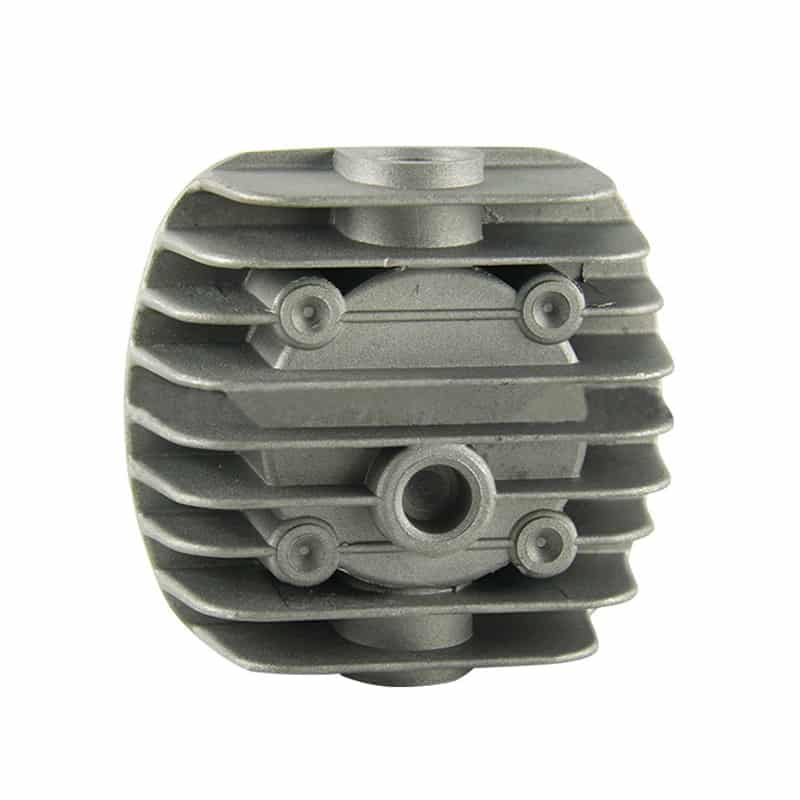
Cylinder Head
A380 aluminum cylinder head with CNC-machined combustion chambers, valve seats, and coolant passages.
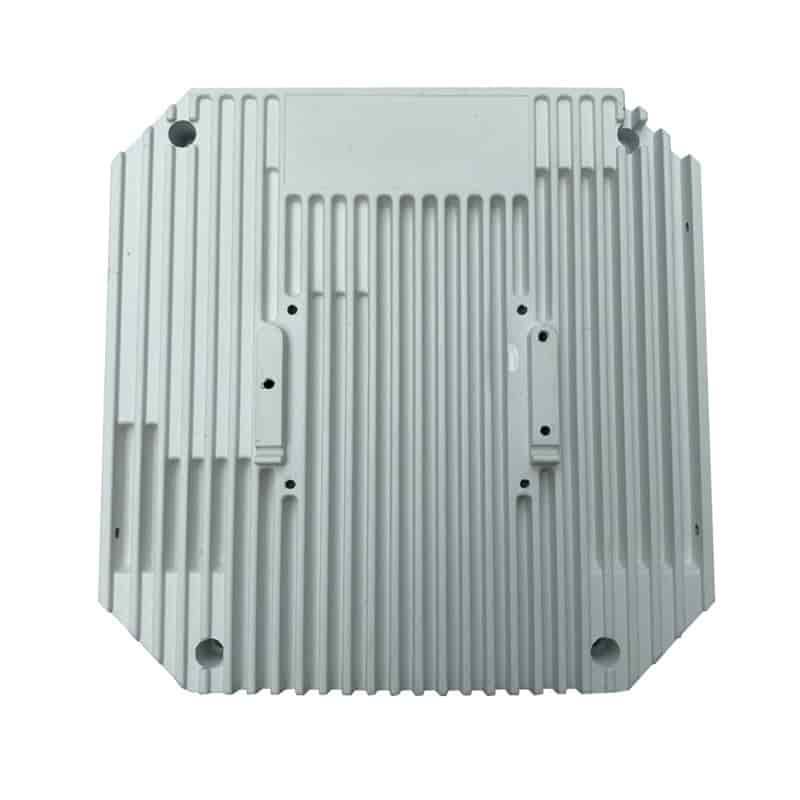
Heatsink
A380 aluminum heat sink plate with CNC-finished mounting surfaces and precision-drilled thermal interface holes.
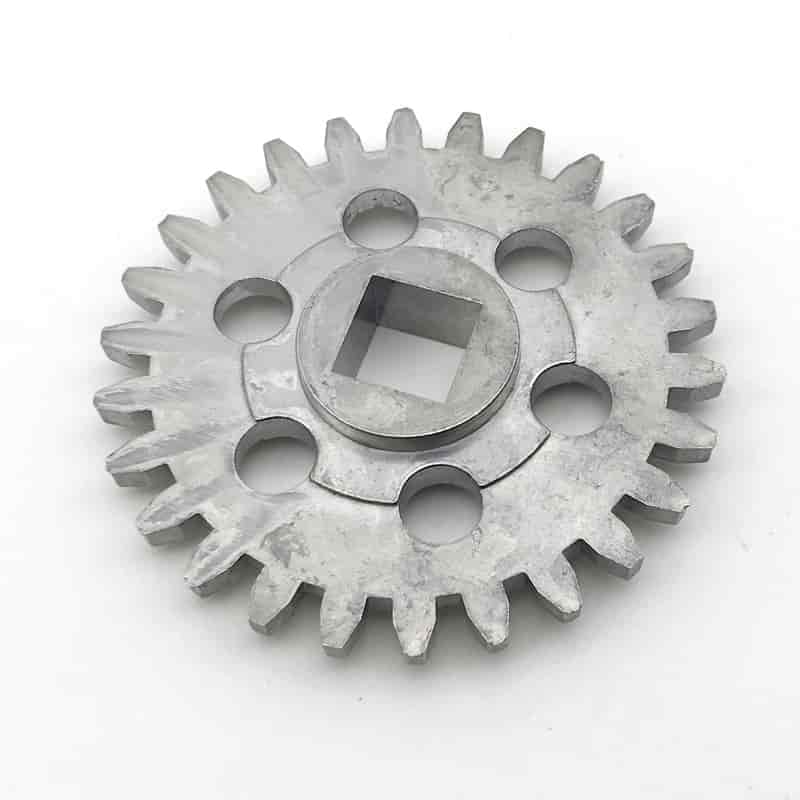
Gear
A380 aluminum spur gear with CNC-machined bore, keyway, and tooth profile finishing for power transmission applications.
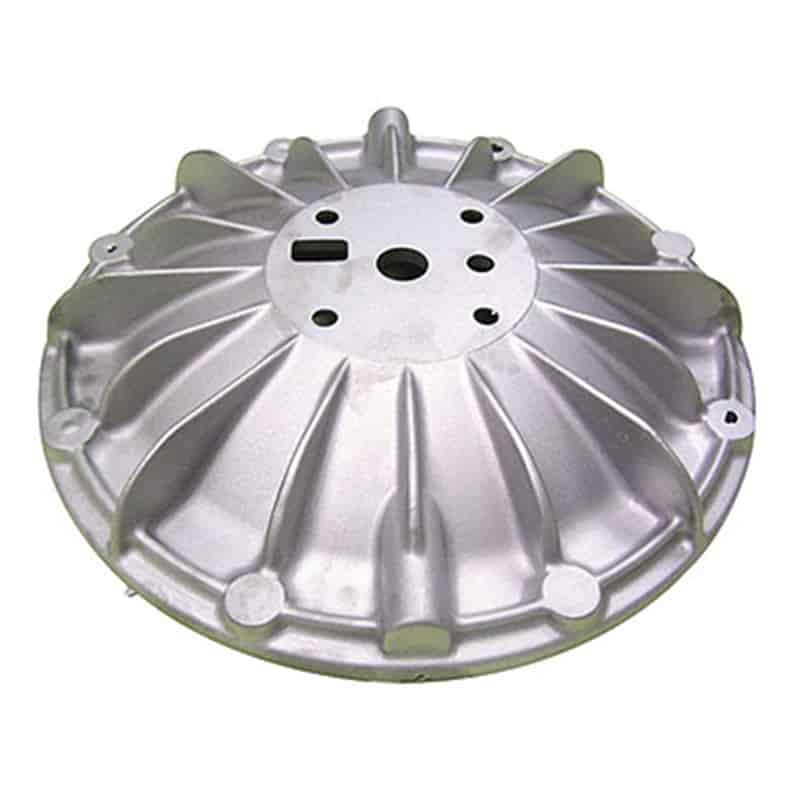
Cover
A380 aluminum equipment cover with CNC-machined sealing grooves, bolt holes, and bearing bores for OEM assemblies.
Industry Applications
A380 aluminum components produced via custom CNC machining aluminum a380 parts in China serve a broad spectrum of industries. The alloy's combination of castability, strength, and thermal performance makes it a default choice across many engineering sectors.
Automotive & Transportation
Engine components, transmission housings, intake manifolds, sensor brackets, and electric vehicle inverter enclosures. A380's lightweight nature supports fuel efficiency and range extension goals in both ICE and EV platforms.
Electronics & Telecom
RF shielding enclosures, router housings, base station heat sinks, and connector bodies. The alloy's thermal conductivity and electromagnetic shielding properties, enhanced by CNC-precision mating surfaces, protect sensitive electronic assemblies.
Industrial Equipment
Pump housings, valve bodies, gearbox cases, motor end shields, and automation machinery frames. A380 provides the structural rigidity and vibration damping required for continuous-duty industrial environments.
Medical & Laboratory
Diagnostic instrument housings, imaging equipment structural components, and laboratory apparatus frames. CNC-machined A380 parts offer smooth, cleanable surfaces and dimensional stability for precision medical and scientific equipment.
Aerospace & Defense
Non-critical structural brackets, avionics enclosures, ground support equipment components, and UAV structural parts. While not used for flight-critical primary structure, A380 serves numerous secondary aerospace applications requiring weight savings.
Consumer Goods & Appliances
Power tool housings, kitchen appliance motor enclosures, audio equipment chassis, and smart home device casings. A380 enables designers to combine structural integrity with premium metallic aesthetics at a competitive production cost.
Our Manufacturing Process
Every order for custom CNC machining aluminum a380 parts in China follows a structured, repeatable workflow designed to ensure dimensional accuracy, material integrity, and on-time delivery from the first article through full production.
Material Sourcing & Verification
A380 ingots or die-cast blanks are sourced from qualified foundries. Each batch is verified by optical emission spectrometry to confirm chemical composition meets ASTM B85 or the specified equivalent standard before any machining begins.
CNC Programming & Setup
Our engineering team generates CAM toolpaths from your 3D model or 2D drawing, selecting optimal cutting strategies, tooling, feeds, and speeds for A380. First-article setup includes fixture validation, tool offset verification, and a dry-run cycle check.
Precision Machining
Parts are machined on calibrated CNC centers with in-process probing for critical dimensions. Coolant is applied to control thermal expansion and improve surface finish. Operators perform in-cycle inspections at defined intervals to maintain batch consistency.
Inspection & Finishing
Finished parts undergo dimensional inspection using CMM, calipers, micrometers, and thread gauges against the drawing. Deburring, surface treatment, and protective packaging are completed before shipment. Material and dimensional records are retained for full traceability.
Advantages of Our A380 CNC Machining Service
When you partner with us for custom CNC machining aluminum a380 parts in China, you gain access to a manufacturing ecosystem optimized for aluminum alloy processing. Here is what sets our service apart for A380-specific production.
Material-Specific Process Optimization
Our machining parameters — spindle speeds, feed rates, chip loads, and coolant concentrations — are specifically tuned for A380's Al-Si-Cu chemistry. This reduces tool wear, minimizes built-up edge on cutting tools, and produces consistently finer surface finishes compared to shops that use generic aluminum parameters across all alloys.
Integrated Casting & Machining
We coordinate directly with qualified A380 die-casting foundries, ensuring that as-cast blanks are designed with appropriate machine stock, gate locations that avoid critical machined features, and porosity levels that are compatible with your CNC machining requirements. This integrated approach reduces lead time and eliminates the risk of casting defects discovered only after machining.
Scalable Production Volume
Whether you need five prototype pieces for fit-and-function testing or 50,000 production parts for an annual program, our capacity scales to match. We maintain dedicated cells for low-volume high-mix work and separate production lines for repeat high-volume orders, ensuring that neither prototype urgency nor production efficiency is compromised.
Comprehensive Quality Documentation
Every shipment includes material test reports (chemical composition), first-article inspection reports, and batch dimensional inspection data as required by your purchase order. We can also provide PPAP-style documentation, process capability studies (Cpk), and full material traceability records from ingot through finished machined component.
Technical FAQ
Answers to the most common technical questions we receive from engineers and procurement specialists sourcing custom CNC machining aluminum a380 parts in China.
What tolerances can you hold on A380 CNC machined parts?
Standard tolerances are ±0.05 mm for general features. On critical dimensions using high-precision machining centers and in-process measurement, we can consistently hold ±0.01 mm. Threaded features are produced to 6H/6g (metric) or 2B/2A (imperial) fits. Specific tolerance capabilities depend on feature size, geometry, and production volume.
Is A380 suitable for anodizing?
A380 can be anodized, but the high silicon and copper content produces a darker, less uniform anodic layer compared to 6061 or 5052 alloys. For decorative applications requiring a bright, uniform color, we recommend chromate conversion coating, powder coating, or painting instead. For functional corrosion protection, both Type II sulfuric anodizing and chromate conversion are viable options.
What is the minimum wall thickness for A380 die-cast parts?
A380 can be die-cast with walls as thin as 1.5 mm in well-designed tooling, though 2.0–2.5 mm is recommended for structural areas that will undergo CNC machining. Very thin sections should be avoided in areas that require subsequent machining, as the casting skin may be entirely removed, potentially exposing subsurface porosity. We review each design for castability before quoting.
Can you machine A380 parts from solid billet instead of die casting?
Yes. While A380 is primarily a die-casting alloy, it is available in wrought billet form for applications where the part geometry or volume does not justify die-casting tooling. Machining from solid A380 billet eliminates casting porosity entirely and is often the preferred approach for low-volume prototype and bridge-production quantities before committing to hard tooling.
What file formats do you accept for quotes and production?
We accept STEP (AP214/AP242), IGES, Parasolid (.x_t), and native SolidWorks, Inventor, CATIA, and NX files for 3D models. For 2D drawings, PDF, DWG, and DXF formats are accepted. A complete drawing with dimensional tolerances, surface finish requirements, material specification, and any critical feature callouts ensures the fastest and most accurate quote.
What is the typical lead time for A380 CNC machined parts?
For parts machined from existing A380 blanks or billet, prototype quantities (1–10 pieces) typically ship in 7–15 working days. Production quantities (100–5,000 pieces) require 3–5 weeks depending on complexity and surface treatment. If die-casting tooling is required, add 4–6 weeks for tool design, fabrication, and first-article sampling before production machining begins.
Your Partner for A380 Precision Components
From initial design review through final inspection and shipment, we are committed to delivering custom CNC machining aluminum a380 parts in China that meet your exact specifications, every time.
Choosing the right manufacturing partner for custom CNC machining aluminum a380 parts in China is a decision that directly impacts your product's performance, cost, and time-to-market. A380 is a forgiving and versatile alloy, but achieving consistent precision requires machining knowledge, material expertise, and a quality system that leaves nothing to chance.
Our facilities are purpose-built for aluminum alloy processing, with dedicated A380 machining cells, material testing capability on site, and an engineering team that understands the interplay between casting quality and machinability. We do not simply remove metal — we optimize every step of the process to ensure that your custom CNC machining aluminum a380 parts in China arrive with the dimensional accuracy, surface finish, and material integrity that your application demands.
Whether your project requires a single prototype for concept validation or a multi-year production program with tens of thousands of parts annually, we have the capacity, expertise, and flexibility to support you. We welcome the opportunity to review your drawings, discuss your design intent, and provide a competitive quotation for your next A380 aluminum component.