
Custom processing of liquid cold plates from China according to drawings
We custom machine and custom fabricate every type of cold plate, liquid cold plate, water cold plate, water cooling plate, cooling plate and liquid cooling plate strictly according to customer drawings, 3D CAD models or physical samples. From our China-based precision machining workshop, we deliver CNC machined aluminum cold plates, vacuum brazed liquid cold plates, milled channel cold plates, embedded tube cold plates and friction stir welded cooling plates — each one machined from drawing and made per customer drawing, with internal flow channels, cooling channel layouts, fluid ports, sealing surfaces and surface finishes defined entirely by your design.
Whether you need a custom CNC machined aluminum cold plate per drawings, vacuum brazed liquid cold plate custom fabrication, or a custom water cooling plate made to customer drawings, every plate is a custom build: custom manufactured from the material you specify (6061 / 6063 aluminum, copper or stainless steel), precision machined on CNC equipment, leak tested and finished to the surface quality and dimensional accuracy your thermal management application demands — from a single prototype piece to high-volume series production. Unlike an air-cooled heat sink, a liquid cold plate transfers heat into a circulating coolant (water, glycol-water mixture, deionized water or dielectric fluid), which makes it the preferred solution for high heat flux heat dissipation where forced-air cooling is no longer sufficient.
CNC machined and brazed cold plates we fabricate
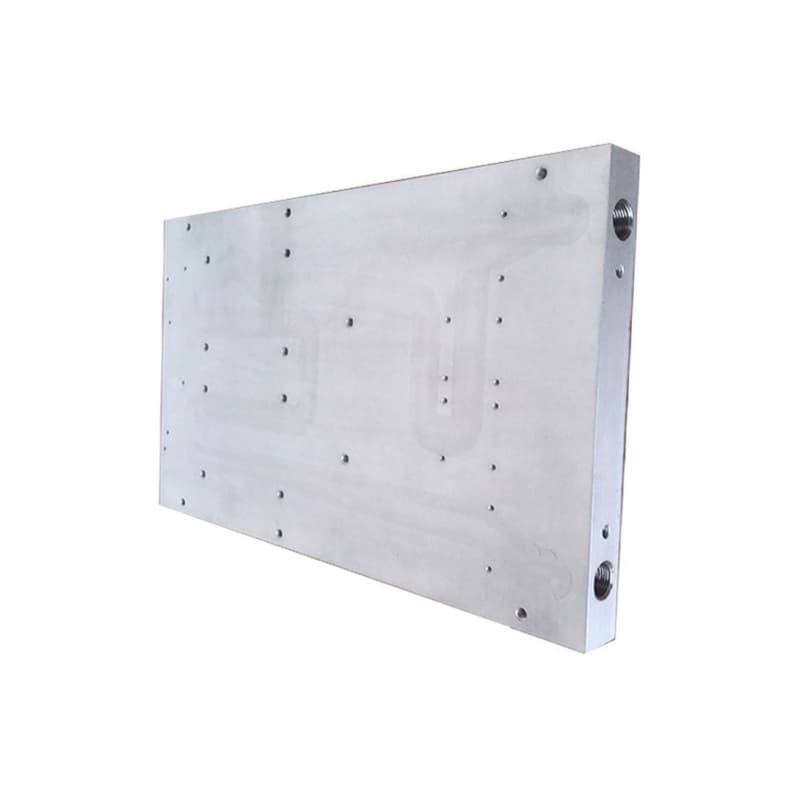
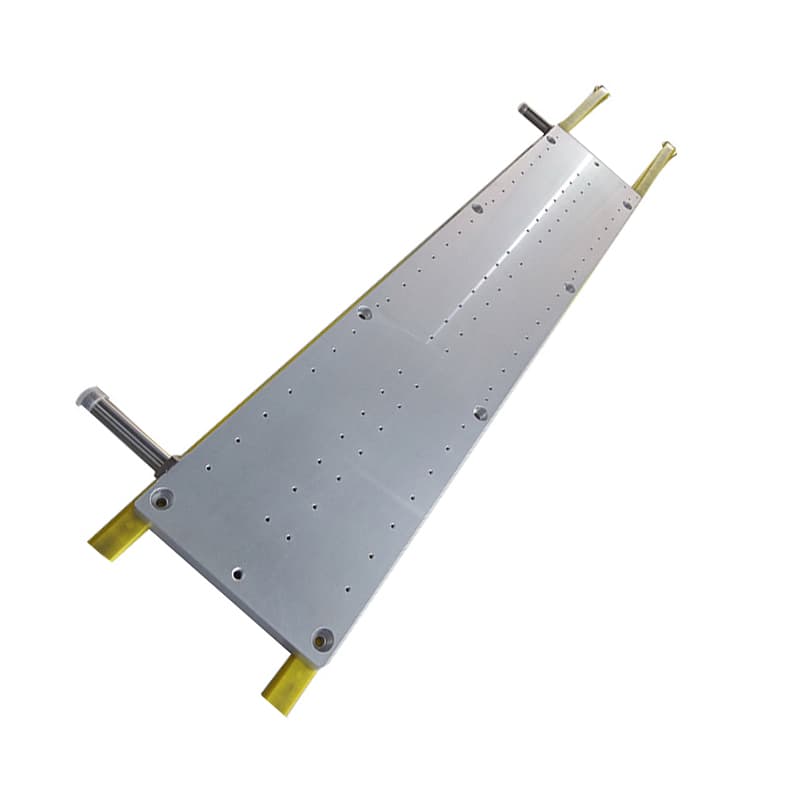
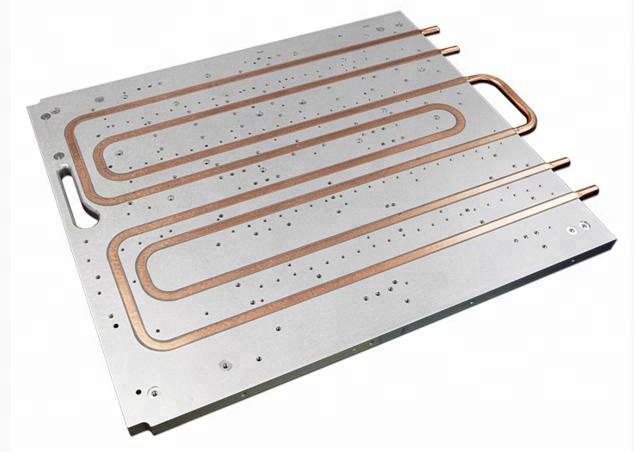
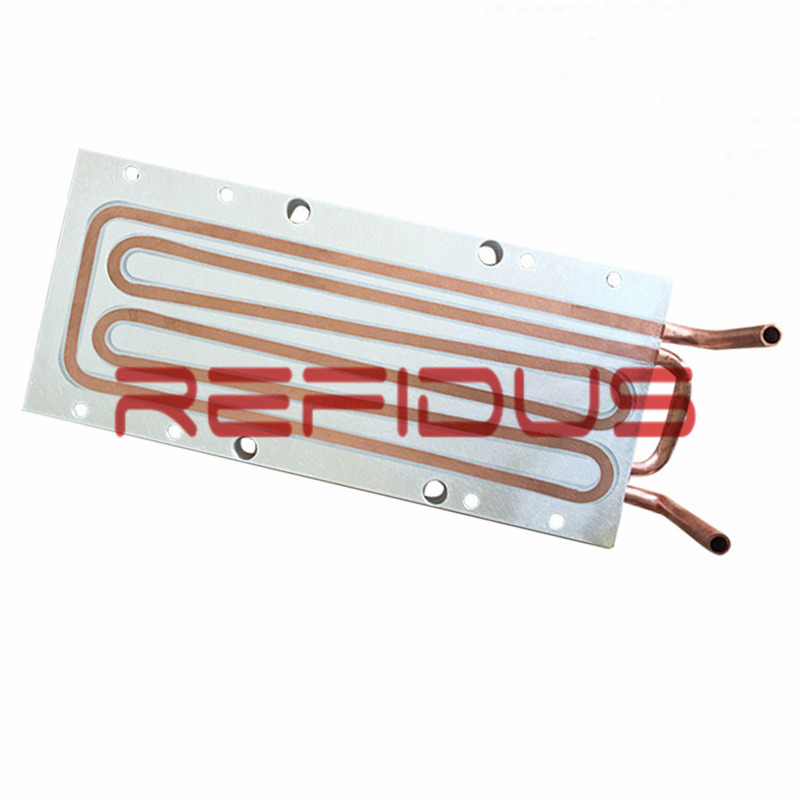
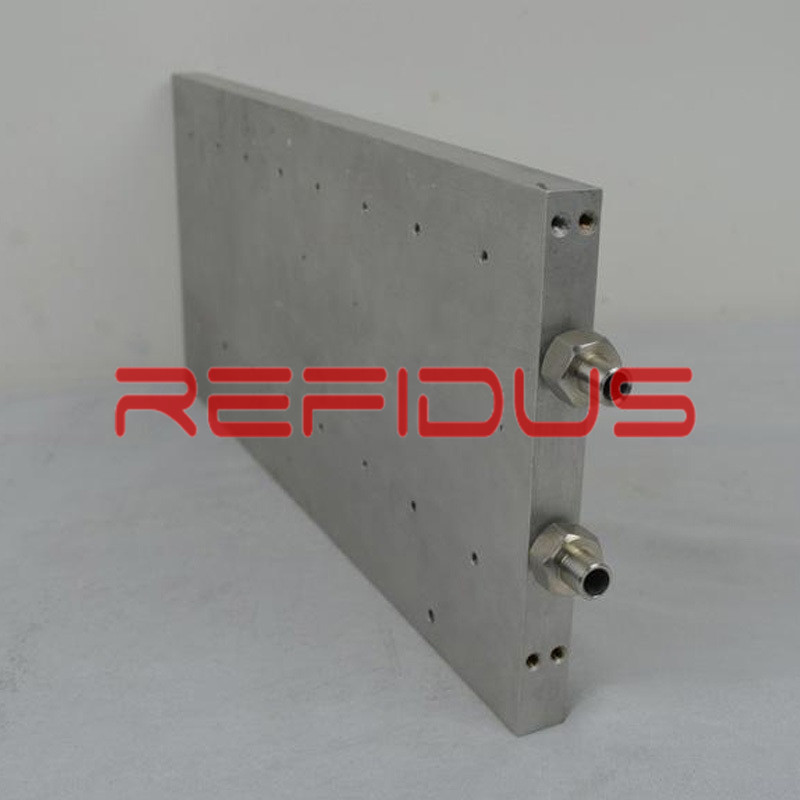
A selection of liquid cooling plates, water cold plates and vacuum brazed cold plates custom manufactured in our China workshop. Every product below is a custom build made to customer drawings or samples — FSW liquid cooling plates, tubed liquid cooling plates, two-surface milled water cooling plates, wind-power cooling plates and vacuum brazed cooling plates developed together with CFD simulation.

Features and advantages of a custom liquid cold plate
A well-designed liquid cooling plate combines efficient heat dissipation, precise temperature uniformity and a compact, customer-defined geometry. The six characteristics below explain why custom machined cold plates have become the standard thermal management solution wherever high heat flux must be controlled in a limited space.
Efficient liquid heat dissipation
Circulating coolant carries heat away from the source far more effectively than air. A CNC machined water cold plate handles high heat flux densities that an ordinary heat sink cannot absorb, keeping IGBT chips, battery cells and laser diodes inside their safe operating temperature range.
Uniform surface temperature
Optimized serpentine channel and parallel internal flow channel layouts balance flow across the whole plate. The result is an even temperature field with minimal hot spots — critical for battery packs, power modules and precision optical systems.
Compact, lightweight custom build
Each cooling plate is CNC machined from a solid aluminum or copper billet exactly to the envelope your assembly allows. Pockets, ribs and thin walls remove unnecessary weight, so the liquid cooling plate fits crowded enclosures without extra adapters.
Leak-tight, robust construction
Vacuum brazed, friction stir welded and TIG-welded joints create one permanently sealed body. Every brazed cold plate and welded water cooling plate undergoes pressure holding and leak testing before surface treatment, supporting years of uninterrupted liquid cooling.
High pressure and corrosion resistance
Wall thickness, cover-plate thickness and channel radius are selected for the operating pressure and coolant chemistry. Aluminum, copper and stainless steel cold plates can be anodized, nickel plated or passivated to resist glycol, deionized water and industrial coolants.
Fully customized channel geometry
Serpentine channels, parallel cooling channels, grid manifolds, pin-fin arrays, turbulator inserts and deep drilled passages are all machined to your drawing. Flow rate, pressure drop and thermal resistance can therefore be tuned to each individual application.
Applications of custom machined water cooling plates
Liquid cold plates are used wherever heat must be removed quietly, compactly and predictably. We custom manufacture cooling plates for the following eight application fields, always made to drawing and adapted to the customer's coolant, power density and installation space.
Electric vehicles
Aluminum liquid cooling plates for traction battery packs, BMS boards, drive motors, onboard chargers and DC/DC converters, including large-format FSW cold plates for battery modules.
Energy storage systems
Water cooling plates for ESS battery racks, container energy storage and charging stations, extending cell cycle life through stable, uniform thermal management.
Power electronics
Copper and aluminum cold plates for IGBT modules, MOSFET arrays, rectifiers, inverters, converters and thyristors operating under high heat flux.
Data centers and computing
Liquid cooling plates for server CPUs and GPUs, rack-scale liquid cooling, AI computing clusters and telecom base stations where air cooling has reached its limit.
Lasers and photonics
Precision machined water cold plates for laser diodes, fiber laser sources, optical amplifiers and electro-optical modules that demand micro-level temperature stability.
Medical equipment
Stainless steel and aluminum cooling plates for medical imaging, laboratory analyzers, therapeutic lasers and temperature-critical diagnostic instruments.
Renewable energy
Cooling plates for wind driven generator converters, photovoltaic inverters and hydrogen fuel cell stacks, built to withstand long outdoor service life.
Industry and transportation
Railway traction converters, aerospace avionics, radar systems, industrial drives, induction heating equipment and semiconductor manufacturing machinery.
Liquid cold plate types classified by fabrication process
The internal flow channel is what defines a cold plate, and the way that channel is created determines pressure rating, size, cost and lead time. We offer six proven cold plate fabrication routes; the final choice is always matched to your drawing, coolant, batch size and performance target.
Vacuum brazed cold plate
The vacuum brazed liquid cold plate is built from a CNC milled base plate carrying the cooling channels and a matching cover sheet, then joined in a vacuum brazing furnace into one monolithic, leak-tight part. It allows highly complex internal flow channels, pin fins and turbulators, and is the preferred process for high-performance IGBT and energy storage cooling plates.
Milled channel cold plate
The milled channel cold plate starts from a solid aluminum block: the serpentine channel or parallel cooling channels are CNC milled directly into the surface and a cover is sealed by brazing or welding. Two-surface milled water cooling plates can carry channels on both faces. Low tooling cost makes this route ideal for prototypes and small batches.
Embedded tube cold plate
An embedded tube cold plate (tubed liquid cooling plate), a copper or stainless steel serpentine tube is pressed, embedded or thermally bonded into a CNC machined aluminum body. The coolant never touches the aluminum, which eliminates galvanic corrosion and allows mixed-material, cost-efficient custom fabrication.
FSW liquid cooling plate
A friction stir welded (FSW) liquid cooling plate joins a channel-machined base and a flat cover using friction stir welding instead of furnace brazing. The process produces large, flat, low-distortion aluminum panels with high weld strength — the mainstream solution for EV battery and large energy storage cold plates.
Drilled passage cold plate
A drilled passage cold plate uses intersecting deep-hole drilled passages (gun drilling) inside a solid plate or bar, with cross ports plugged to guide the flow. With no brazed or welded seams it tolerates very high operating pressure and is commonly chosen for hydraulic, industrial and high-pressure liquid cooling systems.
Custom fabricated welded cold plate
Custom fabricated and custom manufactured assemblies combine CNC machined plates, TIG-welded manifolds, threaded ports, standoffs and quick connectors into one welded module. This made-to-drawing route suits unusual envelopes, retrofit projects and low-volume custom builds that standard cold plates cannot cover.
Materials used for custom cold plates
Material selection balances thermal conductivity, weight, corrosion resistance, brazing behavior and cost. We custom machine cold plates from the four material families below, all machined from drawing according to the alloy and temper stated on your print.
6061 aluminum cold plate
The most common aluminum cold plate alloy: good strength, excellent CNC machinability, well suited to vacuum brazing, friction stir welding and anodizing. A balanced choice for battery, power electronics and general liquid cooling plates.
6063 aluminum cold plate
Higher thermal conductivity and a smoother as-machined surface make the 6063 aluminum cold plate suitable for extruded profiles, thin-walled channels and applications where heat spreading matters more than ultimate mechanical strength.
Copper cold plate
Copper cold plates (C11000 / C101 oxygen-free copper) offer the highest thermal conductivity for concentrated, high heat flux sources such as IGBT dies and laser diodes. They can be precision machined, nickel plated or vacuum brazed.
Stainless steel cold plate
304 / 316L stainless steel cold plates resist deionized water, aggressive coolants and corrosive environments. Welded or brazed stainless cooling plates serve medical, food, chemical and special-purpose thermal management systems.
Surface treatment options for liquid cooling plates
Surface treatment protects the cooling plate from corrosion and wear, guarantees clean sealing surfaces and adapts the part to its coolant and working environment. The following eight finishes can be specified on your drawing; external surfaces and internal cooling channels can be treated according to different requirements.
Clear and color anodizing
Standard sulfuric anodizing on aluminum cold plates builds a uniform protective oxide layer; clear, black or custom colors are available for insulation, corrosion protection and appearance.
Hard anodizing (Type III)
A thick, wear-resistant hard-anodized layer protects internal flow channel walls and mounting faces of aluminum water cooling plates exposed to flowing coolant and mechanical abrasion.
Chromate conversion coating
A thin conductive conversion film protects aluminum cooling plates while keeping electrical conductivity, used where grounding or bonding surfaces must remain conductive.
Electroless nickel plating
Nickel plating on copper, steel or aluminum cold plates delivers even coverage on complex geometries, improving corrosion resistance and preventing oxidation of contact faces.
Passivation and pickling
Stainless steel cold plates are pickled and passivated to remove free iron and weld discoloration, restoring the corrosion-resistant surface of 304 / 316L cooling plates.
Sand and bead blasting
Controlled sandblasting produces a uniform matte texture, removes machining marks and prepares the aluminum or copper surface before anodizing, plating or final assembly.
Brushing, polishing and grinding
Precision surface grinding, brushing and polishing create flat, low-roughness contact surfaces between the cold plate and heat source, minimizing thermal interface resistance.
Powder coating and clean flushing
External powder coating, permanent part-number marking, ultrasonic degreasing and clean flushing of internal cooling channels leave every water cooling plate ready for immediate installation.
Achievable surface quality and dimensional accuracy
As a precision machining workshop, we control every critical feature of a custom cold plate — channel depth, port position, sealing-face flatness and contact-surface roughness. The values below summarize what CNC machined, surface-ground and CMM-inspected liquid cold plates routinely achieve in production; tighter limits can be quoted against the specific drawing.
Dimensional tolerances
Precision-machined features such as fluid ports, O-ring grooves and mounting holes are held to ±0.01 mm where the design requires; general machined dimensions are controlled within ±0.03–0.05 mm. Bore diameters can be machined to H7 / H6 fits for threaded inserts, hose barbs and quick connectors, and overall plate dimensions remain repeatable from the first CNC machined prototype to the last piece of a mass-production batch.
Geometric tolerances
Flatness of mounting and sealing faces is ground down to 0.02 mm so the cold plate mates tightly to IGBT modules, battery modules or device housings. Parallelism and perpendicularity are held to 0.02–0.05 mm, and the true-position tolerance of hole patterns and cooling channel alignments is verified on a coordinate measuring machine before brazing or delivery.
Surface roughness
Sealing faces and heat-source contact surfaces reach Ra 0.8 μm; precision milled internal flow channel walls are typically Ra 1.6 μm; general CNC machined surfaces are Ra 3.2 μm; polished copper cold plate contact surfaces can be finished down to Ra 0.4 μm. Controlled roughness reduces interface resistance, improves O-ring sealing and keeps coolant flow predictable.
Consistency and inspection records
First-article inspection, in-process checks and final reports are standard for every custom build: CMM dimensional reports, 2D projector profile reports, pressure-holding and leak-test records accompany the batch. This inspection discipline keeps a vacuum brazed cold plate or milled water cooling plate identical whether the order is one made-to-drawing sample or several thousand repeat parts.
CNC machined cold plates for every material, function and use
CNC machining sits at the center of every cold plate we deliver: it shapes the cooling channels, the sealing surfaces and the fluid interfaces. The combinations below show how CNC machined precision is paired with different materials, functions and thermal management targets — each combination can be quoted as a custom manufactured, made-per-customer-drawing part.
CNC machined aluminum cold plate for EV battery thermal management
6061 / 6063 aluminum plates with milled or FSW-sealed internal flow channels, large flat formats, ground mounting faces and anodized corrosion protection, made to drawing for traction battery and BMS liquid cooling.
CNC machined copper cold plate for high heat flux IGBT modules
Oxygen-free copper cooling plates with ultra-flat, low-Ra contact surfaces and precision drilled passages, custom fabricated for converters, inverters and power modules where heat flux is concentrated in a small area.
CNC machined vacuum brazed liquid cooling plate for energy storage
Channel-machined base and cover vacuum brazed into a leak-tight assembly with pin-fin or serpentine channel layouts, custom manufactured for ESS racks, charging piles and container energy storage systems.
CNC machined water cold plate for laser heat dissipation
Tight-tolerance water cooling plates with mirror-finished contact areas and balanced parallel cooling channels, custom built for laser diodes, fiber lasers and optical modules that need micro-stable temperatures.
Precision machined stainless steel cooling plate for medical equipment
316L stainless plates with deep drilled passages, passivated surfaces and welded manifolds — a custom fabrication route for medical, laboratory and chemically aggressive liquid cooling environments.
Custom fabricated serpentine channel water cooling plate made to drawing
From a sketch, CAD file or reverse-engineered sample we mill, braze, weld, test and finish embedded tube, tubed and milled-channel cold plates, machined from drawing for prototype and volume programs alike.
Cold plate design and CAE / CFD simulation service
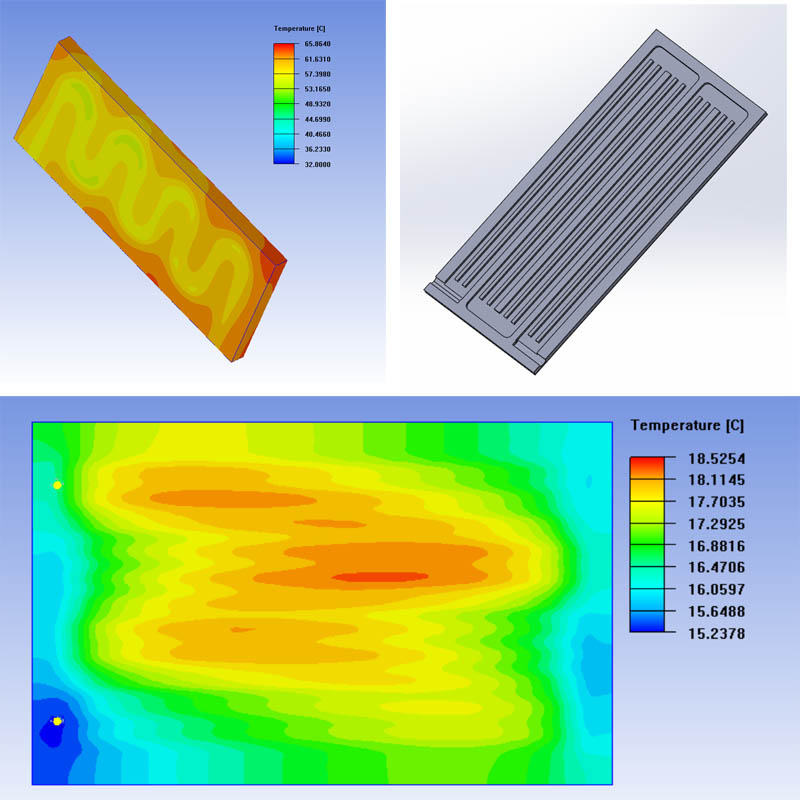
Beyond custom machining and custom fabrication, we support customers at the design stage of a liquid cold plate. Starting from a sketch, a reference sample, a heat-load specification or a preliminary 3D model, our engineering team develops the internal flow channel layout and verifies it through CAE and CFD simulation before any metal is cut.
- Thermal design: heat dissipation calculation, selection of coolant flow rate and estimation of thermal resistance for the target heat flux.
- CFD flow simulation: velocity distribution, pressure drop and flow balance across serpentine channels, parallel cooling channels and manifolds.
- Temperature-field analysis: surface temperature contours and hot-spot prediction to keep IGBT, battery or laser surfaces uniformly cooled.
- Structural review: pressure-bearing and brazing / welding feasibility of the cover plate, channel walls and fluid ports.
- Design for manufacturability: CNC machining, vacuum brazing and leak-testing feedback so the drawing is both efficient and economical to produce.
The result is a custom build that works on the first prototype — a CFD-optimized vacuum brazed liquid cold plate or milled water cooling plate whose simulated performance is confirmed by the machined and tested part.
Precision machining and quality inspection of cold plates
Every custom liquid cold plate passes through CNC material removal and independent dimensional verification. Milling shapes the channels and pockets, turning produces the ports and fittings, and optical projector plus CMM inspection confirm that the finished water cooling plate matches the drawing before it leaves the workshop.
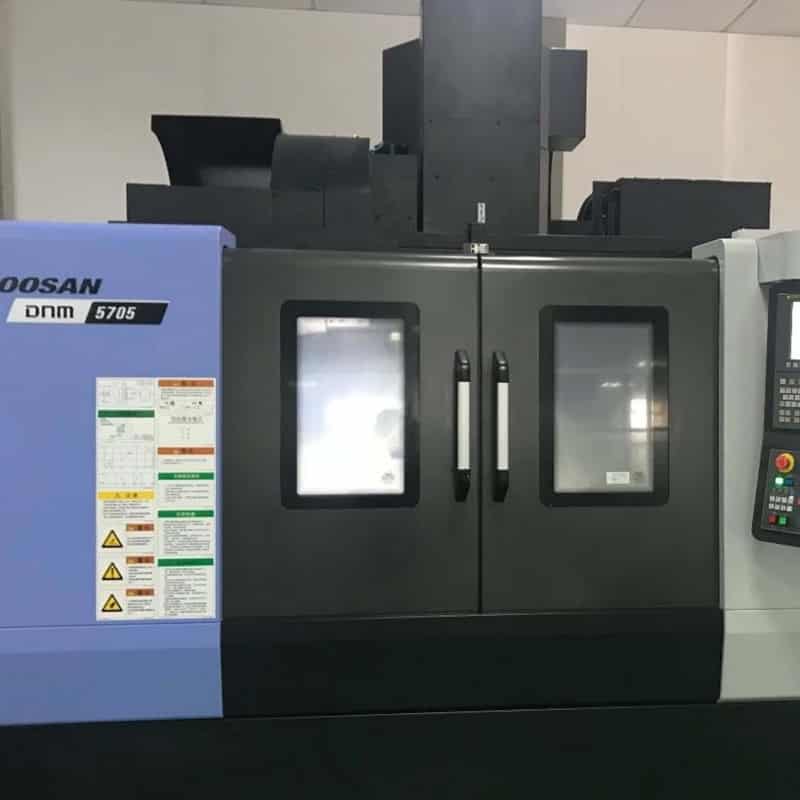
CNC milling service
3-axis, 4-axis and 5-axis CNC milling machines carve serpentine channels, pin-fin arrays, O-ring grooves, pockets and mounting faces from solid aluminum, copper or stainless billets, holding the tight dimensional tolerances a liquid cooling plate requires.
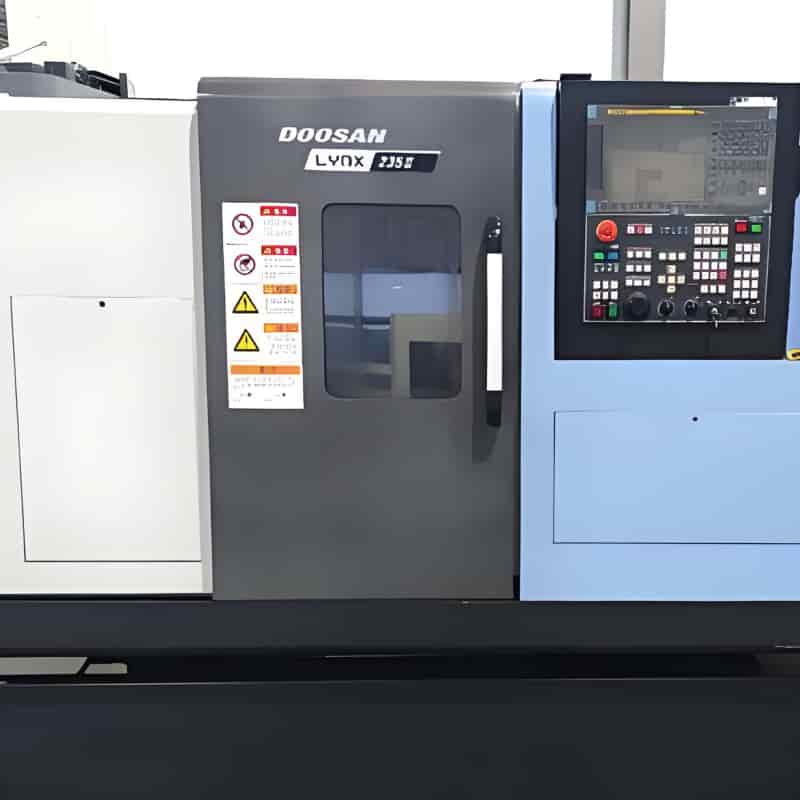
CNC turning service
CNC turning produces threaded fluid ports, hose barb fittings, manifold inserts and connector seats with precise H7/H6 bore fits, so every interface of the custom machined cold plate assembles without leakage.
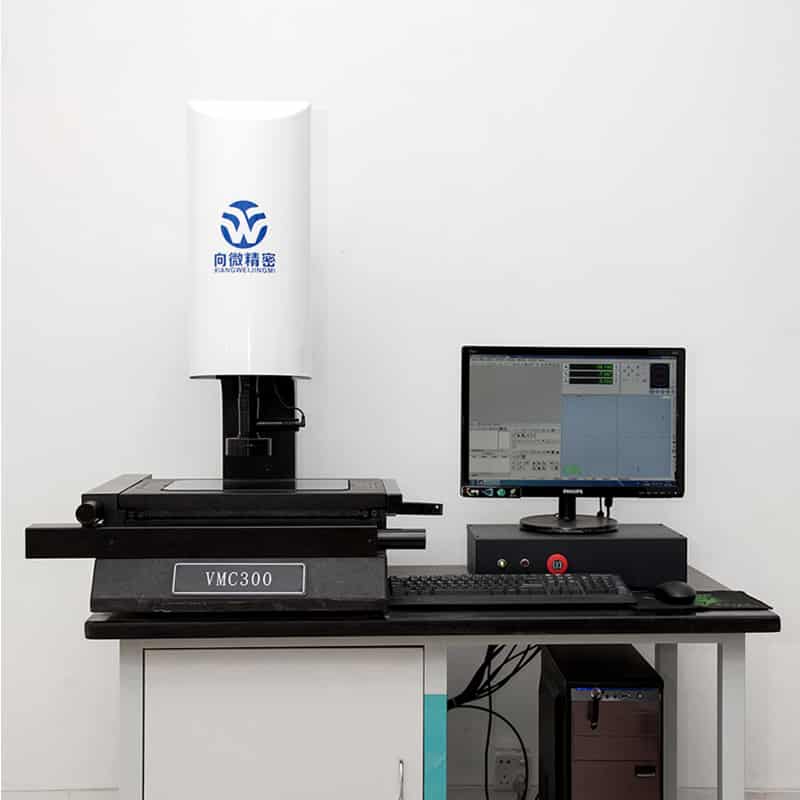
2D optical projector measuring
A 2D profile projector checks channel width, wall thickness, radii and small stamped or machined profiles, providing fast, non-contact verification of the cooling channel geometry defined on the customer drawing.
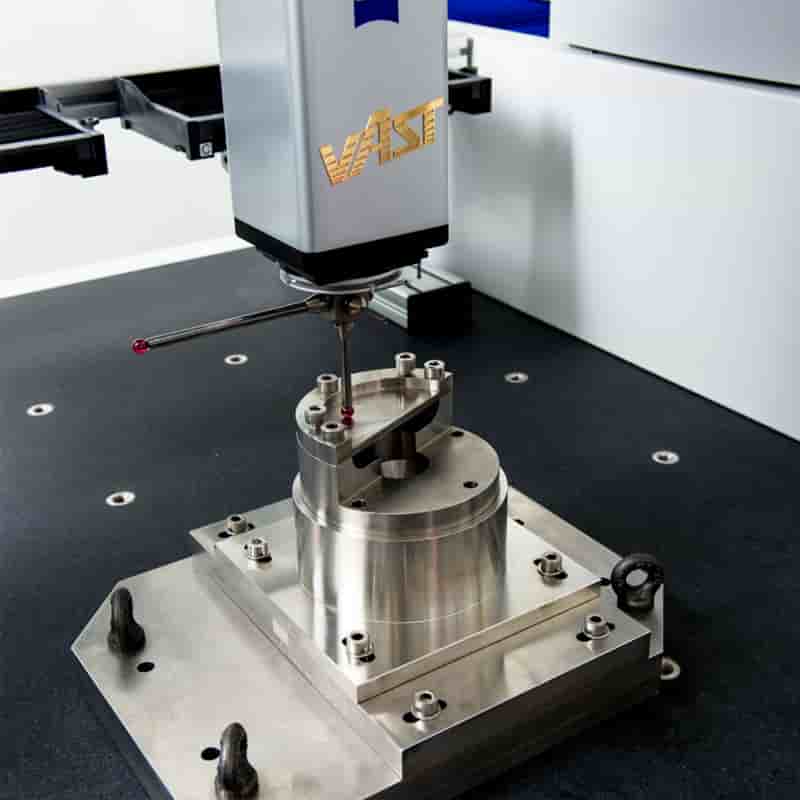
CMM coordinate inspection
A coordinate measuring machine verifies hole positions, flatness, parallelism and overall dimensions of each CNC machined cold plate, generating dimensional reports that guarantee repeatability from prototype to mass production.
Cold plate machining and brazing equipment
The complete process chain for a custom liquid cold plate runs under one roof: CNC machining centers and drill-tap centers shape the raw plate, while a controlled-atmosphere vacuum brazing furnace and friction stir welding equipment form the sealed internal flow channels.
- High-speed CNC vertical machining centers for milling cooling channels, pockets and sealing faces on aluminum, copper and stainless steel cold plates.
- CNC drill-tap centers for port hole patterns, threaded connections and manifold drilling, including deep-hole drilled passages.
- Vacuum brazing furnace for flux-free, leak-tight brazed cold plate assemblies with minimal distortion and clean internal channels.
- Friction stir welding equipment for large-format FSW liquid cooling plates used in EV battery and energy storage programs.
- Surface grinders, leak-test rigs and flushing stations that complete each custom manufactured water cooling plate before shipment.
This integrated equipment set shortens lead times, keeps dimensional control in-house and allows a single custom build to move smoothly into repeat batch production.

Full-process workflow for custom liquid cold plate orders
From the first drawing or sample to repeat batch delivery, each custom cold plate project follows the same transparent eight-step workflow. Customers receive manufacturability feedback, inspection evidence and progress updates at every stage, whether the order is one machined-from-drawing prototype or an ongoing mass-production program.
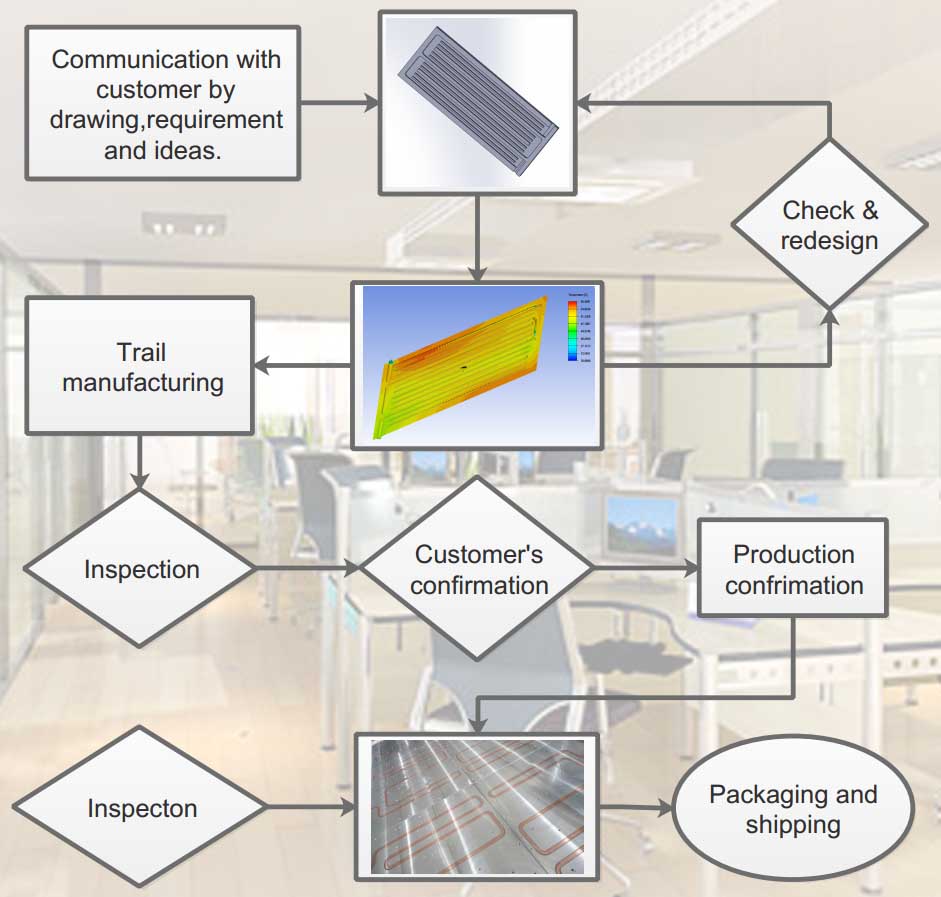
Drawing or sample review2D/3D drawings, specifications or physical samples are reviewed; DFM feedback covers channels, walls, ports and brazing feasibility.
Quotation and planningMaterial, process route (brazed, milled, embedded tube, FSW or drilled), surface treatment and lead time are quoted clearly.
Design and CFD / CAE simulationOptional thermal design, CFD flow and pressure-drop simulation optimize the internal flow channel layout before machining.
Material and CNC programmingSelected 6061/6063 aluminum, copper or stainless stock is prepared and tool paths are programmed for precision machining.
Precision CNC machiningChannels, pockets, drilled passages, threads and sealing faces are CNC machined to the stated tolerances and surface roughness.
Brazing, welding and assemblyVacuum brazing, friction stir welding or TIG welding seals the cooling plate; manifolds and fittings are assembled.
Testing, inspection and finishingCMM and 2D projector inspection, pressure holding and leak testing, followed by anodizing, plating or other specified finishes.
Packaging, delivery and repeat ordersClean flushing, protective packaging and on-time delivery; approved prototypes transfer directly into stable batch production.
From a single custom piece to high-volume production
Custom machining does not mean small orders only. The same drawing-driven process supports engineering samples, pilot runs and series production, with dedicated fixturing and process controls added as quantities grow.
One-off prototype
A single custom build machined from drawing or reverse-engineered from a sample — ideal for design verification, CFD validation and thermal performance testing of a new liquid cold plate.
Small pilot batch
Low-volume runs of several to several dozen water cooling plates for engineering validation, customer qualification and assembly trials, with fast, flexible CNC machining.
Medium repeat batches
Stable repeat orders with fixed tooling, proven brazing or FSW parameters and archived inspection programs, keeping every custom manufactured cooling plate consistent.
High-volume series production
Dedicated fixtures, optimized cycle times and batch-level CMM and leak-test records support thousands of vacuum brazed or FSW liquid cooling plates with stable quality and delivery.
As a China-based custom machining workshop, we are set up to be a long-term manufacturing partner for cold plate, liquid cold plate, water cold plate, water cooling plate, cooling plate and liquid cooling plate programs of any size. Every part is machined from drawing — made to drawing and made per customer drawing — whether the input is a detailed 2D print, a full 3D model or a physical sample to be reverse engineered. Our capability spans the complete keyword set customers search for: custom machining and custom fabrication, CNC machined and precision machining, custom fabricated and custom manufactured assemblies, vacuum brazed cold plate and brazed cold plate construction, milled channel cold plate and embedded tube cold plate designs, serpentine channel and internal flow channel engineering, drilled passage and cooling channel optimization, in aluminum (6061 / 6063), copper and stainless steel.
The three requests we receive most often summarize what we do: a custom CNC machined aluminum cold plate per drawings, vacuum brazed liquid cold plate custom fabrication, and a custom water cooling plate made to customer drawings. Behind each of them stands the same process — thermal design and CFD/CAE simulation where needed, precision CNC milling and turning, vacuum brazing or friction stir welding, CMM and optical inspection, pressure and leak testing, and the specified surface treatment. Send us your drawings or samples, and we will turn them into a leak-tight, dimensionally accurate liquid cooling plate, then scale that same proven part from a single prototype into reliable, repeatable, high-volume production for your liquid cooling and thermal management products.