Custom CNC Machining Battery Cooling Plate | Aluminum Liquid Cold Plate Made to Your Drawings
CNC Machining Battery Cooling Plate Manufacturer | Milled-from-Solid & FSW Aluminum Water Cold Plates, OEM per Drawing
Custom CNC Machining Battery Cooling Plate — Built Exactly to Your Drawings
If you are looking for CNC machining battery cooling plate suppliers that work from your drawings instead of pushing a standard catalog part, you are in the right place. We are a non-standard custom CNC machining shop, and battery liquid cold plates are one of the parts we produce every week for thermal-management customers in Europe, North America, Russia, Pakistan and South Africa. Send us your 2D/3D drawing and requirements, and we machine the plate to your dimensions, channel layout, tolerances, surface finish and leak-tightness class — no forced redesign, no “close enough” standard size.
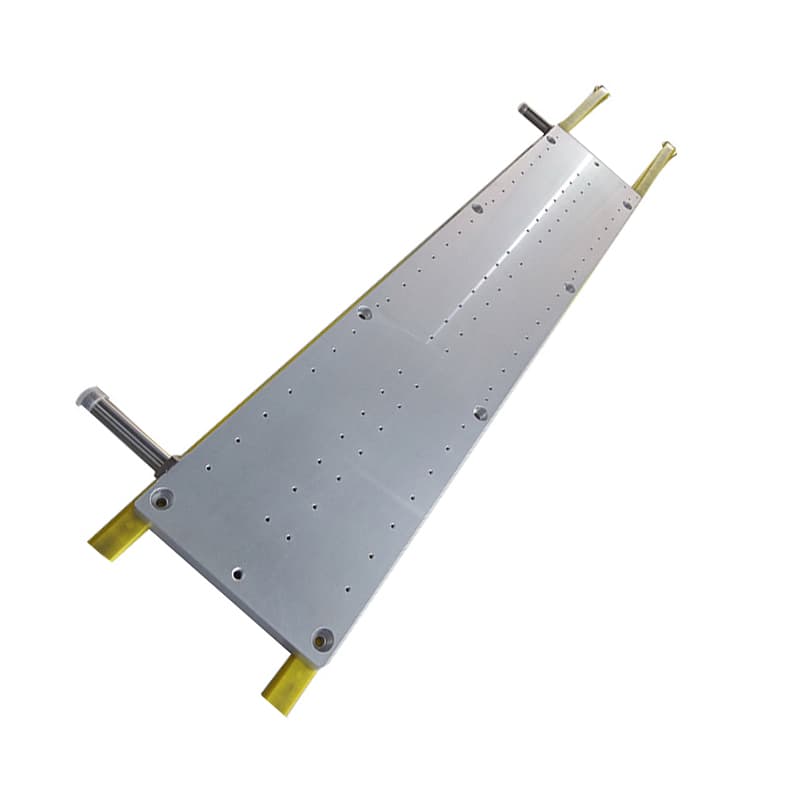
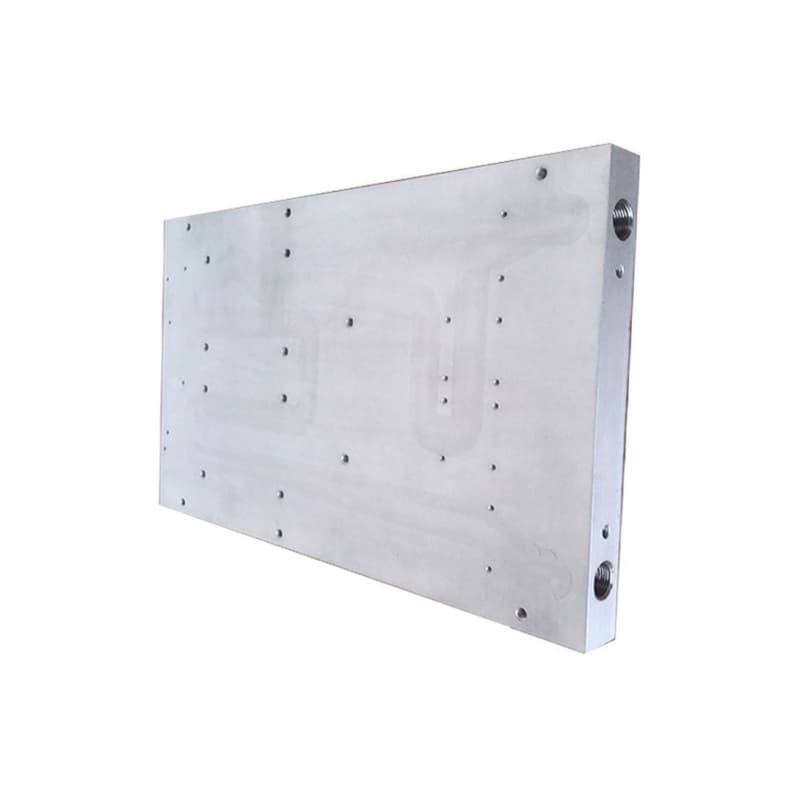
We make CNC machined battery cooling plates from solid aluminum blocks, as well as FSW (friction stir welded), vacuum-brazed and embedded-tube versions. Prototype runs of 1–10 pieces, pilot batches and serial production are all supported.
What Is a CNC Machined Battery Cooling Plate?
A battery cooling plate (also called a liquid cold plate, water cooling plate or battery cold plate) is a flat metal part with internal coolant channels that sits in direct contact with battery modules. A water-glycol mixture (or dielectric coolant) circulates through the channels and carries heat away from the cells, keeping the pack inside its working temperature window and holding the cell-to-cell temperature difference small — typically within 2–5 °C across the plate when the channel layout is well designed.
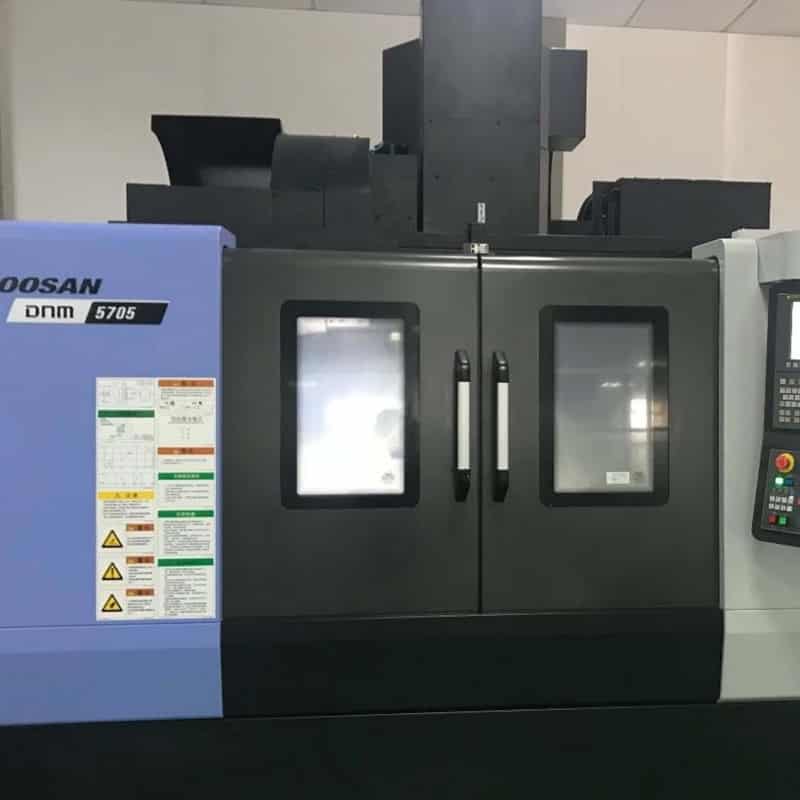
In the CNC machining route, the channels, manifolds, inlet/outlet ports, O-ring grooves, threaded holes, locating pockets and mounting faces are all cut on CNC milling centers from a solid plate, rather than stamped or die-cast. This gives you free-form channel paths, tight dimensional control and dense feature integration — which is why machined cold plates are the first choice for low-to-medium volumes, prototype validation and packs with non-standard shapes.
Construction Types We Can Machine to Order
| Type | How It Is Built | Best For |
|---|---|---|
| Milled-from-solid + cover plate | Channels CNC-milled into a solid base; cover sealed by FSW, TIG welding, brazing, or bolts + O-rings | Prototypes and custom packs; channels can be revised by changing the program only |
| FSW (friction stir welded) | CNC-milled base + lid joined by friction stir welding (solid-state, no filler), then finish-milled flat | Serial EV/ESS plates; high weld strength, low distortion, no porosity |
| Vacuum / CAB brazed | Stacked aluminum sheets brazed in furnace, then CNC-finished on sealing faces and ports | Thin microchannel plates, high-volume runs |
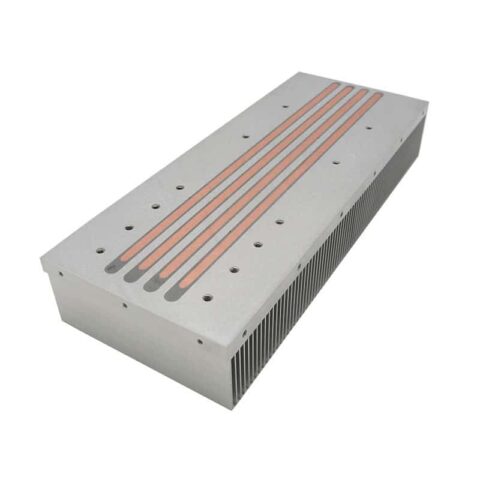
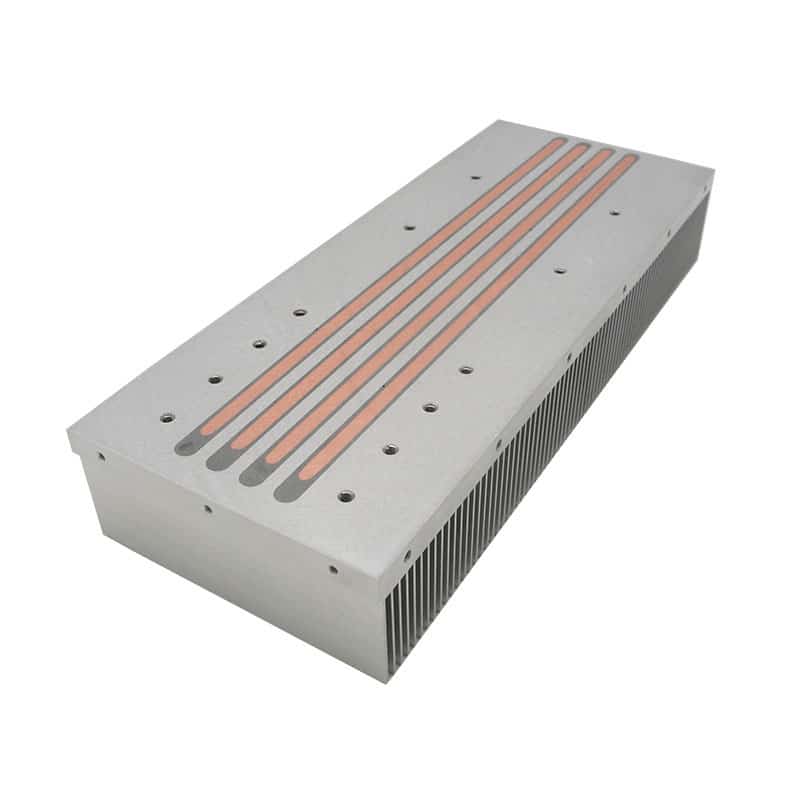
| Embedded copper-tube plate | Copper tube (C1100) pressed/glued into a CNC-machined aluminum body | Mixed aluminum/copper designs, repair-friendly constructions |
| Gun-drilled / deep-hole plate | Straight intersecting coolant holes drilled into a solid block, cross-holes plugged and deburred | Thick structural plates, IGBT / power-electronics cold plates |
Not sure which construction fits your design? Send the drawing — our process engineer will point out the trade-offs in cost, flatness and leak risk before you commit.
Materials We Routinely Work With
| Material | Typical Use | Notes |
|---|---|---|
| Aluminum 6061-T6 | Most common machined cold plates | Good strength, stable machining, proven for welded and O-ring-sealed plates |
| Aluminum 6063 / 6060 | Plates where thermal conductivity matters first | Softer, easier to extrude; good for FSW assemblies |
| Aluminum 3003 / 1100 | Brazed plate constructions | Brazing-friendly, high thermal conductivity |
| Copper C1100 tube / C101 plate | Embedded-tube or all-copper cold plates | Highest conductivity for concentrated heat loads |
| Stainless steel 304 / 316L | Aggressive coolants, medical/food-grade or high-pressure circuits | Slower to machine but corrosion-resistant — a material we run daily in our standard custom-parts business |
Mill test certificates (EN 10204 3.1), material traceability and third-party material reports are available on request.
Typical Specifications (Every Plate Is Built to Your Drawing)
| Item | Typical Range / Standard Practice |
|---|---|
| Plate size | From small module plates ~100 mm up to pack-level plates 1000 mm+; long, thin and irregular shapes welcome |
| Plate thickness | Commonly 6–20 mm finished; thinner brazed versions possible |
| Channel width | 3–15 mm, per your flow/pressure-drop calculation |
| Channel depth | 2–8 mm; minimum web/land thickness reviewed in DFM |
| Channel pattern | Serpentine, parallel, multi-manifold, counter-flow, custom free-form paths |
| Dimensional tolerance | ±0.05 mm on machined features where the drawing requires; general ±0.1 mm |
| Surface flatness (contact face) | Typically 0.1 mm/m as machined; surface-ground to ≤0.02–0.05 mm when TIM contact demands it |
| Surface roughness | Ra 1.6–3.2 standard; Ra 0.8 available on contact/sealing faces |
| Working pressure | Commonly 3–4 bar; proof/burst pressure tested per your spec (e.g. 1.5× working pressure) |
| Leak tightness | 100% pressure-decay / water-pressure test on every plate; helium mass-spectrometry leak test available |
| Ports / fittings | Threaded G/NPT/metric ports, hose barbs, quick connectors, welded stubs — machined to match your fitting |
| Surface treatment | As-machined, sandblasted, clear/hard anodizing, chromate-free conversion coating, nickel plating, stainless passivation |
The numbers above are typical industry practice, not a fixed catalog: if your drawing calls out different values, the drawing wins.
Our Production Process — From Drawing to Packed Plate
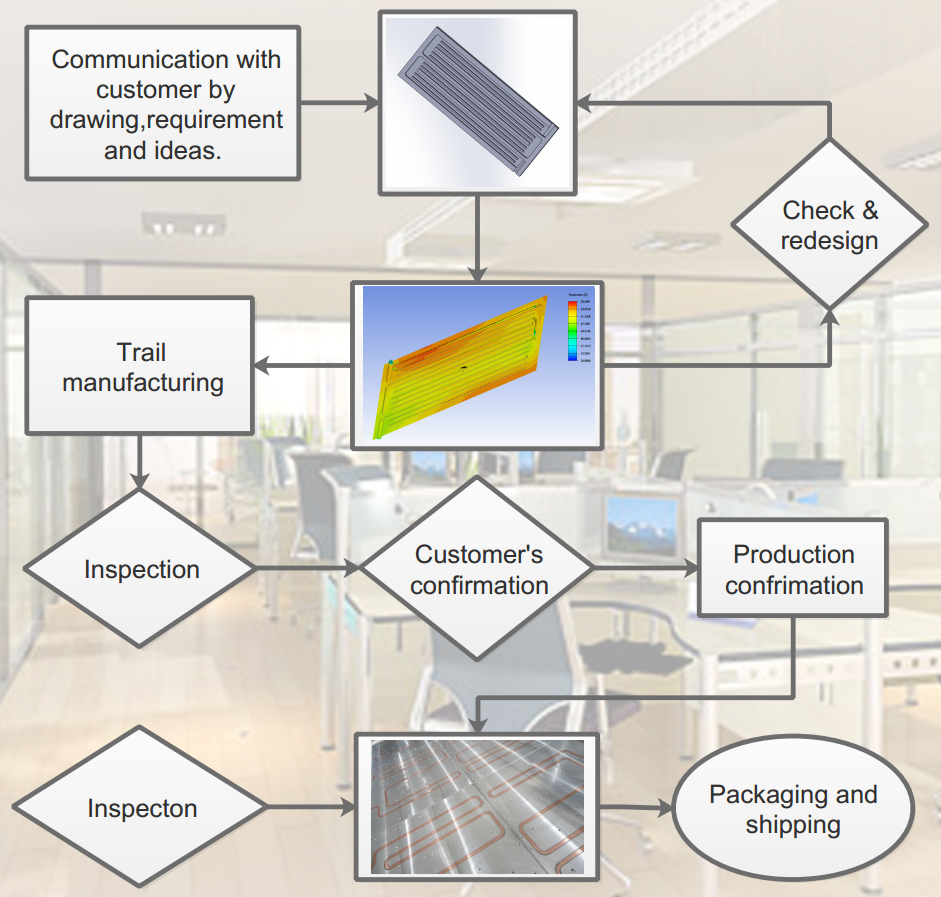
- Drawing review (DFM). We check minimum wall thickness between channels, corner radii vs. available cutters, cross-hole deburring access, cover-plate welding land width, and machining allowance needed to true the plate after welding. You get a written DFM note with any risk points before production starts.
- Quotation. Based on raw material size, machining time, welding/sealing method, surface treatment and inspection level — itemized, no hidden charges.
- Material preparation. Saw-cut from certified plate stock; soft-jaw and vacuum fixturing used for large thin plates to control the “potato-chip” warping that clamping causes.
- Rough and finish CNC machining. 3-/4-/5-axis centers mill channels, manifolds, O-ring grooves, ports, threads and mounting features; finish passes are planned so the sealing face is cut last in one setup.
- Sealing / joining. FSW, TIG, vacuum brazing, or bolted O-ring closure — whichever construction your design specifies.
- Second finish cut / surface grinding. Welded plates are always re-machined on the contact face after joining, because welding moves material; this is what delivers the flatness your TIM layer needs.
- Deburring and internal cleaning. Cross-holes and channel ends deburred; chips and cutting fluid flushed out of internal passages; cleanliness checked before sealing.
- Surface treatment per drawing.
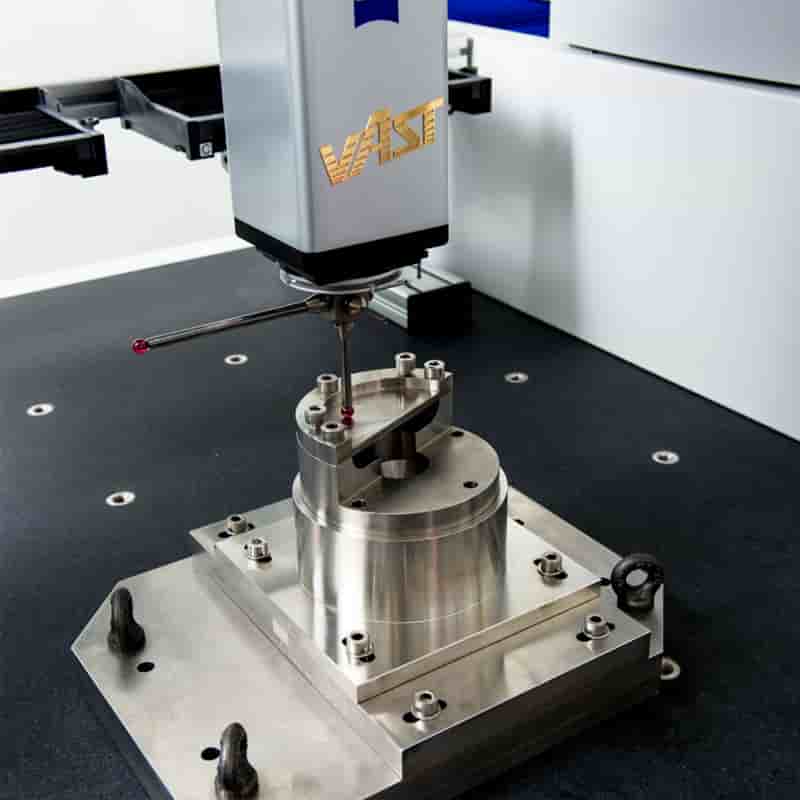
- 100% leak test + CMM dimensional report. Every single plate is pressure tested, not just a sample from the batch.
- Protective packaging. Foam/film separation, anti-scratch stacking, export carton or plywood case for sea/air freight.
Quality Control and Documentation
- 100% leak test: water-pressure or air pressure-decay test on every plate, with hold time and pressure recorded; helium leak detection for ultra-tight requirements.
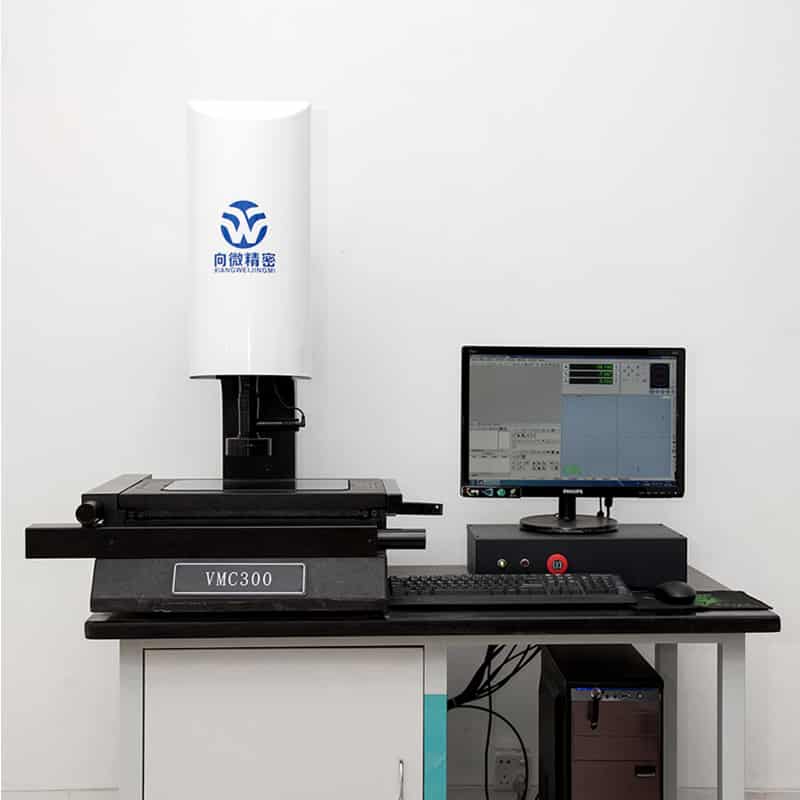
- Dimensional inspection: CMM and height-gauge reports on critical dimensions, flatness and port positions; first-article inspection (FAI) report for new part numbers.
- Traceability: material heat number, machine routing and inspection records kept per batch.
- Documentation package on request: FAI, PPAP-level paperwork, material certificates, leak-test records, surface-treatment certificates, inspection photos before shipment.
Where Custom Machined Cooling Plates Are Used
- Electric vehicle battery packs — prismatic, cylindrical and pouch cell modules (BEV, commercial vehicle, e-bus, AGV, forklift, marine)
- Stationary energy storage systems (ESS / BESS), battery cabinets and containerized storage
- Charging modules, DC fast-charger rectifiers, IGBT/SiC converters and inverters
- Data-center liquid cooling, server and GPU cold plates
- Medical, laser, aerospace and fuel-cell equipment requiring non-standard thermal plates
Why Buy from a Custom CNC Machining Shop Instead of a Catalog Supplier?
- Your geometry is the spec, not our mold. No tooling fee for channel changes on milled plates; design iterations only need a new program.
- Mixed materials in one supply chain. Aluminum plates, stainless fittings, copper-tube hybrids — the same shop, the same drawing standards.
- Small orders are normal business for us. 1-piece prototypes, 5-piece validation batches and repeat serial orders all get full process control; we do not reserve engineering attention only for big programs.
- Tight communication on problem drawings. Thin walls, deep narrow channels, cross-drilled intersections, post-weld distortion — we tell you what is risky and propose a manufacturable alternative instead of silently loosening your tolerance.
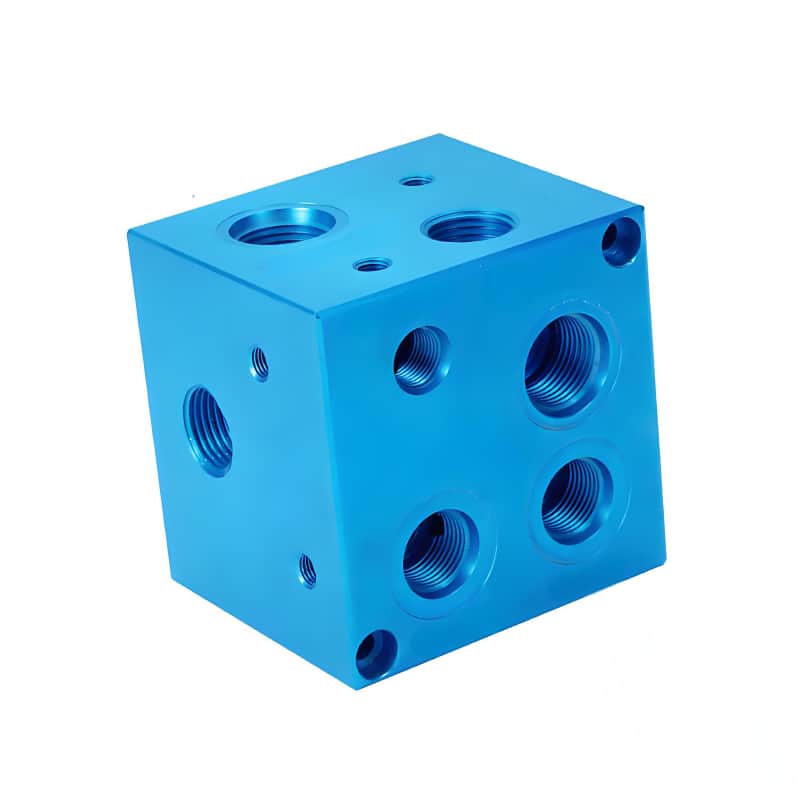
- Non-standard is our core business. Beyond cooling plates, we machine custom flanges, manifolds, valve blocks, threaded fittings and structural parts, so sub-assemblies around the cold plate can be consolidated into one purchase order.
How to Order / What to Send
Send us the following and we usually quote within 24 working hours:
- 3D model: STEP / IGES / X_T (Parasolid); 2D drawing: PDF/DWG with tolerances, material and surface treatment called out
- Quantity (prototype / batch / annual volume)
- Working medium, flow rate, working pressure and required leak-test standard, if applicable
- Required certificates and inspection reports
- Target delivery date and shipping terms
Files without complete tolerances are fine — our engineer will mark the open points and confirm them with you instead of guessing.
FAQ
Q1: Can you produce a CNC machining battery cooling plate fully according to our drawing? Yes. Drawings and customer specifications are the binding standard. We manufacture to your dimensions, material, tolerances and finish, and we submit a DFM review before cutting metal so any manufacturability issue is solved up front.
Q2: Which is better for my plate — milled-from-solid, FSW or brazed construction? Milled-from-solid with a sealed cover is most flexible and cheapest for prototypes and small batches; FSW gives stronger, cleaner welds and suits medium-to-large aluminum plates in series; vacuum brazing suits very thin microchannel plates at high volume. Share your drawing and target volume, and we will recommend the route with numbers.
Q3: How do you guarantee no leakage? Every plate undergoes a 100% pressure-decay or hydrostatic leak test after sealing and surface treatment; helium mass-spectrometry testing is available for stricter leak rates. Test pressure, hold time and result are recorded per piece.
Q4: What flatness can you achieve on the battery contact surface? As-machined flatness is typically around 0.1 mm per meter; after post-weld finish milling or surface grinding we routinely hold 0.02–0.05 mm. Specify your required flatness on the drawing and we will build the process to meet it.
Q5: Can you make just a prototype, or do you only accept volume orders? Prototypes are welcome. Most new projects start with 1–10 sample plates for thermal and leak validation, then move to repeat batches. CNC-machined constructions need no hard tooling, so prototype lead time is short.
Q6: Which file formats do you accept? STEP, IGES, X_T, SolidWorks, AutoCAD DWG/DXF and dimensioned PDF drawings. Hand sketches with full dimensions can also be quoted.
Q7: Do you provide material and inspection documents? Yes — EN 10204 3.1 mill certificates, CMM inspection reports, FAI reports and leak-test records are available; tell us which ones you need at PO stage.