Custom CNC Turned SS304 Threaded Pipe Fittings Manufacturer – NPT/BSPP
NPT vs BSPP difference;60 degree NPT 55 degree BSPP thread;tapered vs parallel pipe thread;custom thread form crest root;2D profile projector thread inspection;NPTF BSPT dryseal thread
If your equipment uses threaded pipe connections, you already know the failure pattern: a fitting that screws in smoothly on the bench starts weeping after two weeks in service, or a replacement part from a new supplier won’t seat because the thread form is “close” but not right. Most of these problems are not bad luck. They come down to three things — the wrong material for the medium, a thread profile whose crest and root were never properly controlled, and inspection that stopped at a hand-tight GO gauge.
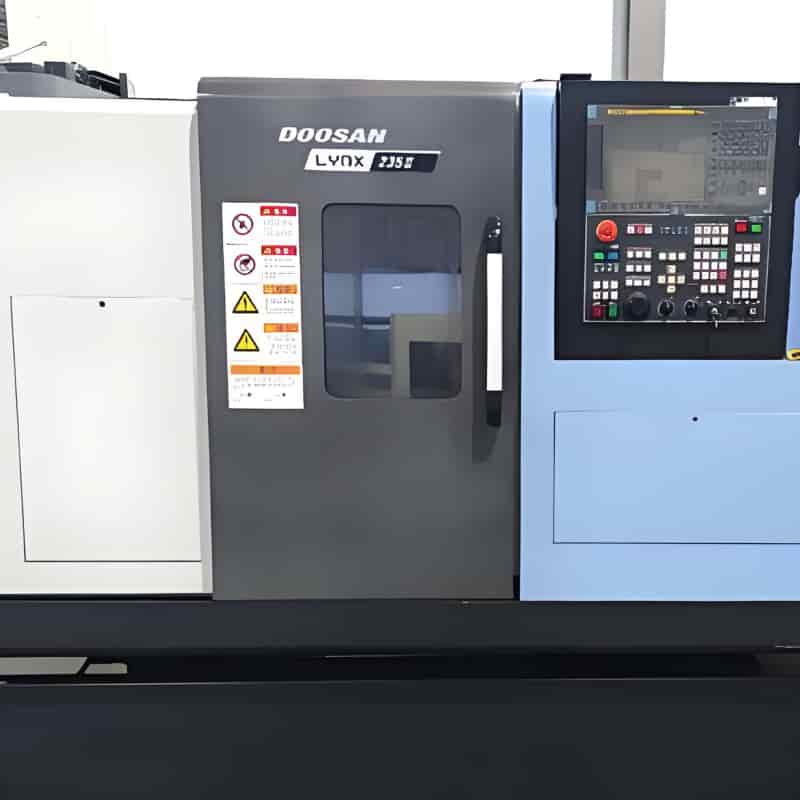
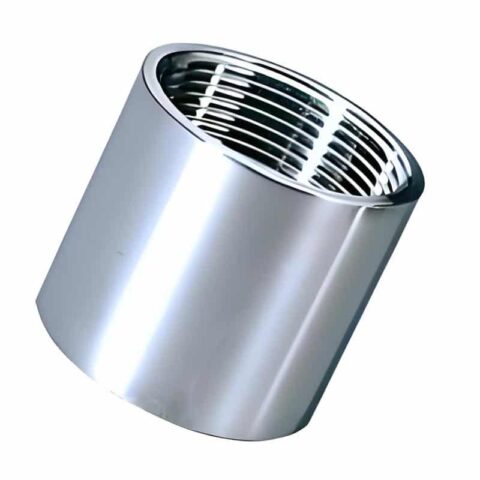
We are a custom CNC turning manufacturer of non-standard machined parts, and stainless steel 304 threaded pipe fittings in NPT and BSPP form are one of the jobs we run every week. This article explains exactly what we make, why SS304 is (and is not) the right choice, how NPT and BSPP differ, how we control the thread form — crest and root included — and how every critical thread is checked on a 2D profile projector before it leaves the shop. If you are an engineer, buyer, or product developer specifying a custom fitting, this is the technical detail you can use to audit us or any other supplier.
What “custom CNC turned threaded fittings” actually covers
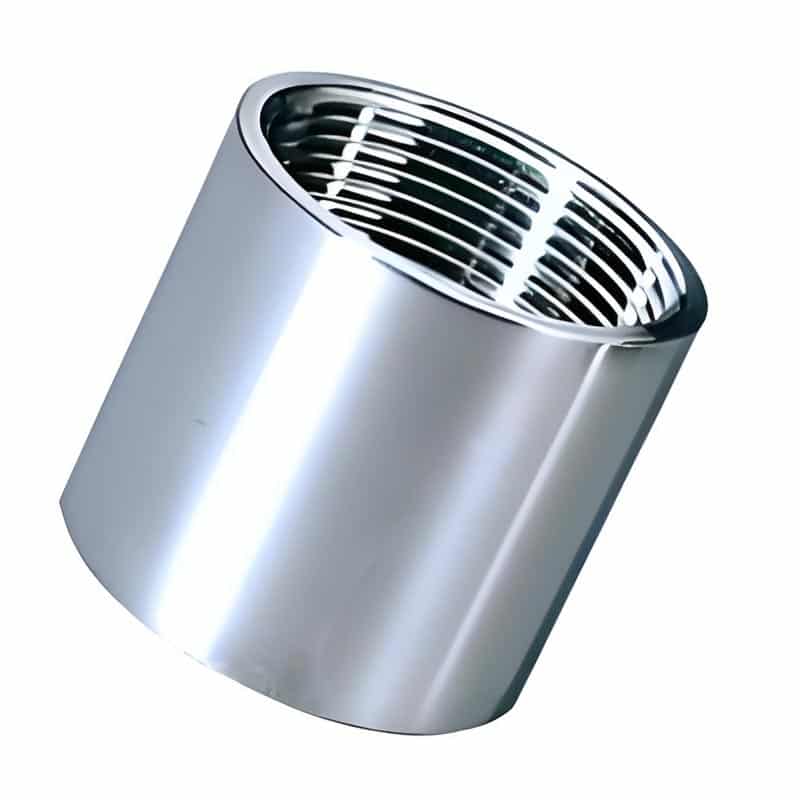
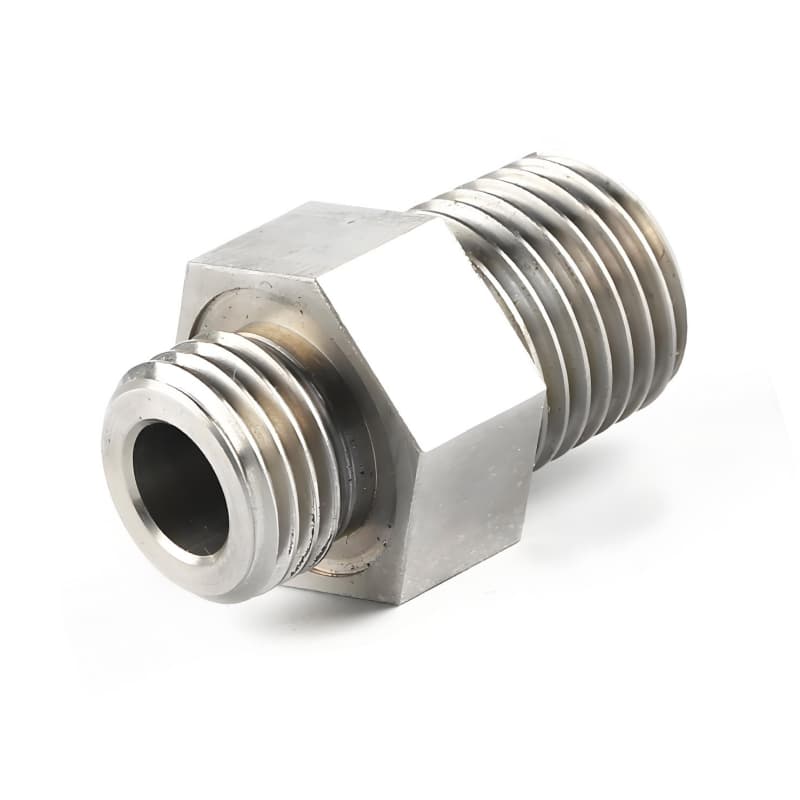
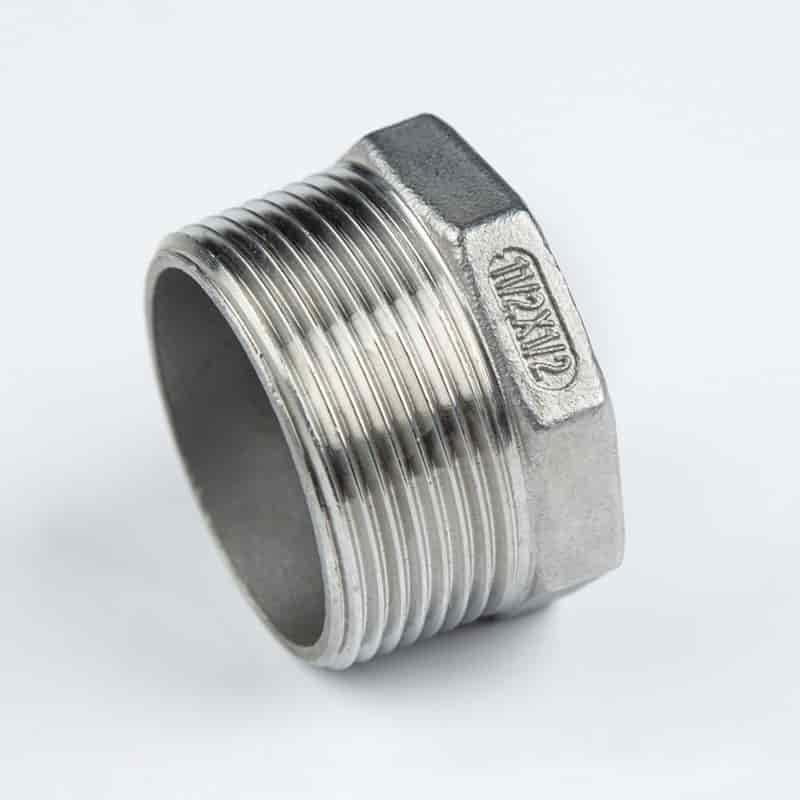
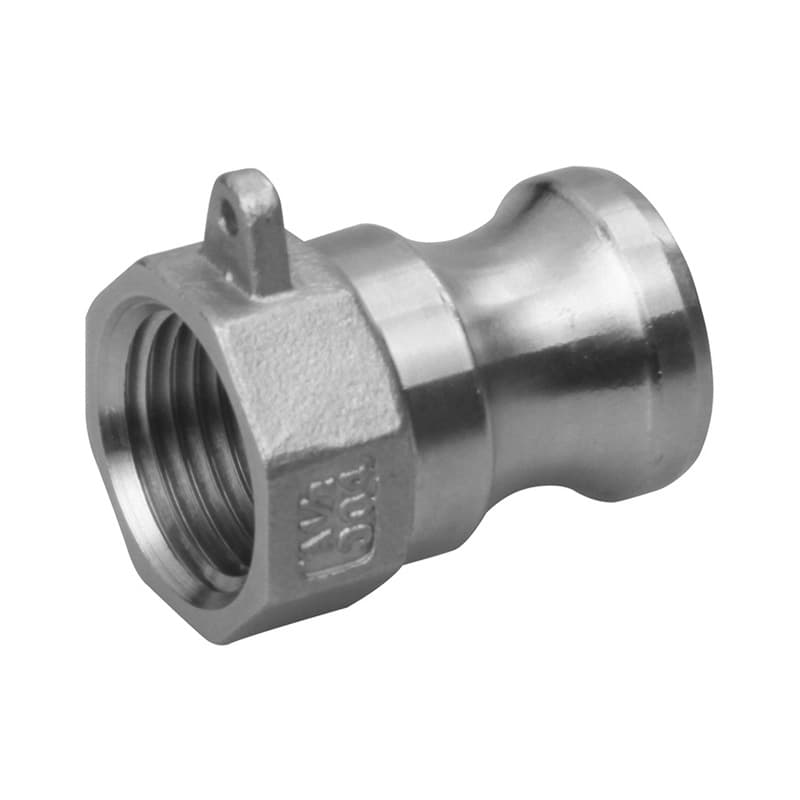
We do not keep a catalog of off-the-shelf fittings. Every order is built to a customer drawing, a marked-up sketch, or a physical sample we reverse-engineer. The parts most commonly produced on our CNC lathes include:
- Male and female threaded nipples, adapters, and couplings
- NPT-to-BSPP and BSPP-to-NPT conversion adapters (male/female, male/male, female/female)
- Reducing and expanding fittings with different thread sizes or standards at each end
- Pipe plugs, blanks, bleed screws, and threaded end caps
- Standpipes, extended nipples, and fittings with a turned hex, wrench flat, or knurl
- Hose barbs and push-on tails finished with an NPT or BSPP thread at the other end
- Bulkhead fittings, elbow blanks for secondary milling, and fittings combined with cross-holes, slots, or O-ring grooves
- Assemblies where a turned stainless body is paired with a bonded seal, PTFE washer, or Loctite-prepped thread
Typical working range is 1/16 in. through 2 in. pipe thread sizes (roughly DN6–DN50), in lengths up to what a bar-fed CNC lathe can handle from round or hex bar stock. Larger sizes and short-run forgings can be quoted case by case. Because the parts are turned from solid bar rather than cast, wall sections, shoulder positions, hex sizes, and undercut geometry are all open to your drawing — you are not locked into a standard forging shape.
Why SS304, and where its limits are
Type 304 (UNS S30400, EN 1.4301) is the default stainless for general-purpose threaded fittings for good reason. Its typical chemistry is 18–20% chromium and 8–10.5% nickel, carbon held to 0.08% max. In the annealed condition the bar we machine from is rated at roughly 515 MPa minimum tensile strength and 205 MPa minimum yield, with a density around 7.93 g/cm³. In practice that gives a fitting that:
- Resists rust in atmospheric, fresh-water, and washdown environments without plating or painting
- Handles most food, beverage, dairy, and pharmaceutical media, and tolerates the standard CIP chemicals at working concentration
- Stands up to many common chemicals, dilute acids, alkalis, alcohols, oils, and compressed air
- Works across a wide temperature range and holds good mechanical toughness below zero
- Takes a clean machined finish, passivates well per ASTM A967, and can be electropolished when the application demands a smoother, easier-to-clean surface
We will also tell you where 304 stops being the right call, because a fitting that fails in six months costs more than the material upgrade:
- Salt water, brine, chloride-rich media, coastal splash zones: move to 316/316L. The molybdenum in 316 is what resists chloride pitting; 304 does not have it.
- Welded assemblies with corrosion concerns at the weld: consider 304L (low carbon) or 316L.
- High-strength or high-hardness requirements: as-machined 304 work-hardens at the surface, but it is not a high-strength alloy; a martensitic grade or different design may be needed.
304 also work-hardens fast under the tool if the cut skids instead of shearing, which is exactly why thread quality on 304 depends on sharp inserts, a sensible infeed strategy, and controlled passes — covered below. Material certificates (mill test certificates to EN 10204 3.1) and, where required, positive material identification (PMI) are available with every order, so the grade is documented rather than promised.
NPT vs BSPP: the two thread systems we cut every day
The two thread standards buyers ask for most are NPT (American) and BSPP (international). They look similar at a glance. They are not interchangeable, and forcing them together is one of the most common causes of torn fittings and slow leaks in the field.
表格
| Feature | NPT | BSPP (G) |
|---|---|---|
| Standard | ASME B1.20.1 | ISO 228-1 |
| Flank angle | 60° | 55° (Whitworth form) |
| Geometry | Tapered, 1:16 on diameter (3/4 in. per foot) | Parallel — constant diameter |
| Crest and root form | Truncated (controlled flat at crest and root) | Rounded crest and root |
| How it seals | Thread interference + PTFE tape or pipe compound | Thread does not seal; an O-ring, bonded washer, or gasket seats on a face/shoulder |
| Common markets | North America; global oil & gas, many hydraulic systems | Europe, UK, Asia, Australia; pneumatics, instrumentation, general industry |
| TPI, common sizes | 1/8-27, 1/4-18, 3/8-18, 1/2-14, 3/4-14, 1-11.5, 1-1/4-11.5, 1-1/2-11.5, 2-11.5 | 1/8-28, 1/4-19, 3/8-19, 1/2-14, 3/4-14, 1-11, 1-1/4-11, 1-1/2-11, 2-11 |
Two practical points worth being precise about:
- A 60° NPT male will start into a 55° BSPP female of similar size — and then bind. The pitches happen to be close at 1/2 in. and 3/4 in. (both 14 TPI), which is exactly how cross-threading accidents happen. The flank angles don’t match, so contact is point-to-point instead of flank-to-flank, and the seal never develops properly.
- BSPP is not BSPT. BSPP (G, ISO 228-1) is parallel and seals on a washer or O-ring. BSPT (R external, Rp/Rc internal, ISO 7-1) is tapered at 1:16 and seals on the threads. We cut both. We also cut NPTF dryseal threads (ASME B1.20.3), metric parallel and tapered threads, UN/UNF, and modified or fully custom profiles when an existing mating part defines the geometry.
When a customer is unsure which standard their mating port uses, we ask for a photo, a measured pitch (threads per inch or millimeter pitch), the port diameter, and whether sealing happens on the threads or a face. That is usually enough to identify it without guessing.
Custom thread forms: why the crest and root decide whether a fitting survives
A thread is not just “a spiral groove.” Its load-carrying behavior, seal quality, and fatigue life live in the profile geometry — the two flanks, the crest on top, and the root at the bottom. This is where commodity fittings and controlled custom fittings diverge.
Crest, root, and flank in plain terms
- Crest: the surface at the top of the thread ridge — the major-diameter surface on an external thread. Its width (flat) or radius, and its freedom from burrs and torn material, decide how the pair assembles and how load distributes across the first engaged threads.
- Root: the surface at the bottom of the groove, joining neighboring flanks — the minor-diameter surface. The root is where stress concentrates under pressure cycling and vibration. A too-sharp root notch is a fatigue crack waiting to start; a correctly rounded or truncated root spreads that load.
- Flanks: the straight load-bearing faces. Flank angle (60° included for NPT, 55° for BSPP), flank straightness, and surface finish determine how evenly the male and female share the load.
NPT uses a truncated V with controlled-width flats at crest and root. BSPP uses the Whitworth form with deliberately rounded crests and roots (the theoretical root radius is 0.1373 × pitch, thread depth 0.6403 × pitch) — the radius is part of why the 55° form tolerates vibration and repeated make-and-break well. ISO metric forms carry their own truncation rules (for an external metric thread the basic crest truncation is H/8, where H = 0.866 × pitch). When we cut to a standard, those values are not advisory; they are what the profile projector checks against.
What “we can customize the thread form” means in production
Beyond standard NPT/BSPP, drawings frequently call for a modified profile: a wider or narrower crest flat, a specific root radius to match an existing mating fitting, a reduced thread height (stub profile) for a thin wall, a custom pitch, or a blended lead-in. This is routine for us, and it is controlled at four points:
- Insert geometry. The threading insert’s nose radius and tip form must match the pitch and the required root. A nose radius that is too wide cannot reach the bottom of the groove — the root stays shallow, pitch diameter looks deceptively correct on a micrometer, and the part fails a ring gauge. Too small, and the root notch becomes a stress riser. We match insert to pitch, not the other way around.
- Infeed method. Straight radial infeed cuts both flanks simultaneously and work-hardens 304 aggressively. We use a modified flank infeed (typically around 29–30°) so the chip flows off one face, heat goes with the chip, and the finished flank stays clean rather than glazed.
- Multiple spring passes with wear compensation. 304 threads are cut in several graduated passes plus finish passes, with tool wear offsets adjusted against measured parts. A worn insert shows up first as a dull crest finish and a drifting root dimension — that is when the insert gets changed, not after scrap appears.
- Start, runout, and deburr. Thread lead-ins get a controlled chamfer; runout grooves or reliefs are added where the drawing calls for them; crests are deburred without rounding off the load-bearing profile. Every fitting leaves with threads protected by caps or sleeve wrap so the crest is not dinged in transit.
The result is what you would expect to measure: flanks with a consistent machined finish (typically Ra 1.6 or better on the threaded surface), crests free of torn folds and loose burrs, roots to the specified flat or radius, and a thread that gauges the same on the first and last piece of a 5,000-piece run.
How a 2D profile projector verifies the thread form
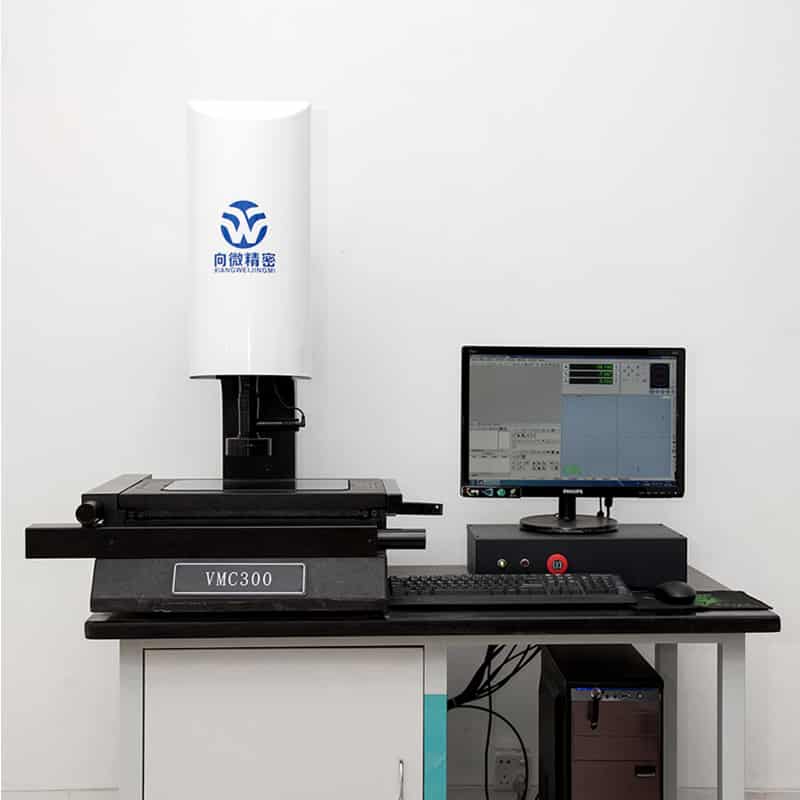
A GO/NO-GO ring or plug gauge tells you whether a thread assembles within tolerance. It does not tell you why, and it cannot show you the shape. That is the job of our 2D profile projector (optical comparator), and it is the reason we can hold customers to a custom crest/root specification instead of relying on gauge fit alone.
The inspection routine
- The fitting is sectioned or fixtured so the optical axis cuts through the thread axis — the projector images the true axial profile, not a foreshortened surface view.
- Collimated light throws a magnified silhouette of the thread onto the projector screen (at 10×, 20×, or 50× as the pitch demands).
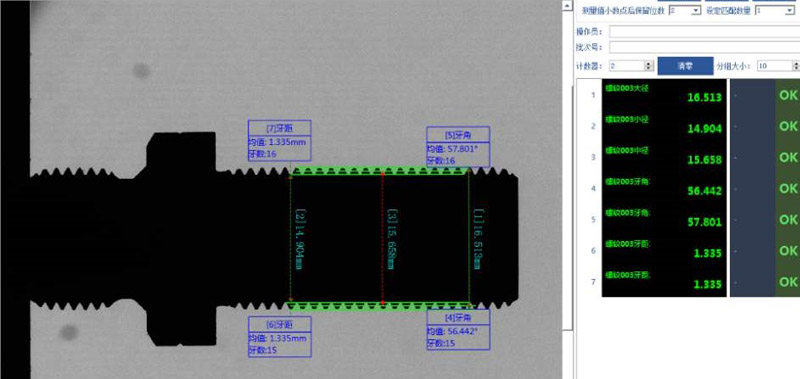
- The magnified silhouette is overlaid on a standard thread-form template for NPT or BSPP, or measured directly with screen crosshairs and the digital readout / measuring software when the profile is custom.
- First-piece inspection is 100% profile check before the run is released; in-process patrols repeat it at fixed intervals, and any insert change triggers a fresh first-piece.
What the projected profile lets us measure
- Included angle and each half-angle separately. A symmetric 60° can hide one flank at 29° and the other at 31°; measuring left and right half-angles independently catches exactly that kind of error, down to a fraction of a degree.
- Pitch, single and cumulative. Adjacent-pitch error and pitch accumulation over the full engaged length show directly on the screen — the kind of error that makes a fitting tighten early or feel “rough” over the last two turns.
- Crest flat width or crest radius, measured against the standard’s truncation or the customer drawing.
- Root flat width or root radius — the dimension that governs the stress concentration and the one a ring gauge can never report.
- Taper on NPT/BSPT threads. The projected flank line is checked against the 1:16 taper, so a cone that is slightly too steep or too shallow is caught at the profile level rather than inferred from standoff.
- Major and minor diameter, thread depth, lead-in chamfer angle, and runout/relief geometry.
- Surface defects visible in silhouette: torn flanks, chatter, folded crests, incomplete last threads.
Profile projection is non-contact, so a soft stainless surface cannot be bruised by the measurement itself. It also produces images we can archive: inspection photos and measured records travel with the shipment when a customer wants them in the PPAP/first-article package.
2D projector measuring precision, 0.002mm
The projector is one layer, not the whole QC stack
Thread form verification sits alongside the rest of the inspection plan:
- GO / NO-GO ring and plug gauges for assembly acceptance on NPT, NPTF, BSPP, and BSPT
- Three-wire measurement of pitch diameter where a numeric value is required
- Calibrated micrometers, bore gauges, and height instruments for lengths, hexes, shoulders, and bore diameters; tolerances in the IT6–IT8 band are routine on turned features
- Surface roughness tester for Ra verification on flanks and sealing faces
- Thread standoff measurement on tapered threads (L1 hand-tight engagement plane)
- Passivation per ASTM A967 with post-passivation cleanliness checks; electropolishing or bead blasting when specified
- EN 10204 3.1 material certificates, dimensional reports, and first-article inspection reports on request
Industries these fittings go into
Because 304 is a general-purpose grade and both NPT and BSPP are globally recognized, these fittings show up across nearly every sector that moves fluid or gas:
- Food, beverage, and dairy: syrup lines, CO₂ and compressed-air drops, brewing and bottling equipment, washdown manifolds — often electropolished, always free of paint or zinc that would flake into product zones.
- Pharmaceutical and biotech: utility connections, pure-water skids, laboratory and analytical equipment where cleanability and material traceability matter.
- Water treatment and reverse osmosis: filter housings, dosing lines, membrane housings, softeners, and residential/commercial purification equipment.
- Chemicals and cosmetics: transfer of dilute acids, alkalis, solvents, detergents, creams, and alcohols where 304’s compatibility chart is satisfied (we flag anything chloride-heavy toward 316).
- Pneumatics and hydraulics: FRL units, valve manifolds, cylinder ports, and instrument air — BSPP with bonded seals is especially common on European-sourced equipment.
- Automotive and commercial vehicles: coolant, air-brake auxiliary circuits, SCR/AdBlue dosing, test rigs and production-line tooling.
- Agriculture and irrigation: sprayer booms, fertilizer dosing (media-dependent), greenhouse and livestock water systems.
- Marine and offshore deck equipment: fresh-water and deck-wash systems in 304, seawater-side components upgraded to 316.
- Fire protection, HVAC, and refrigeration: gauge cocks, drain fittings, pressure tap adapters, heat-pump and chiller connections.
- Gas systems: natural gas and LPG regulator and burner connections in the appropriate regional thread standard.
- Medical and dental equipment: instrument air, vacuum, and fluid-cartridge connections.
- Renewable energy and heat transfer: solar thermal manifolds, biomass boilers, battery-cooling test stands.
- General machine building, robotics, printing, and packaging: lubrication lines, sensor mounts, coolant delivery, and anywhere a compact stainless threaded adapter is needed.
For maintenance and spare-parts buyers, our reverse-engineering route matters: send the old fitting (even a worn or broken one), and we recover the thread standard, pitch, profile, crest/root form, and all body dimensions on the projector and measuring instruments, then produce a drop-in replacement. This is often the only practical way to keep imported legacy machines running.
How a custom order moves through the shop
- You send what you have: PDF/DWG/STEP/IGS drawing, a sketch with dimensions, or a physical sample. Tolerances, thread standard, material certificate needs, and surface requirements should be marked; if they are not, we come back with questions rather than assumptions.
- DFM feedback and quotation. We flag thin walls, deep blind holes, thread lengths that exceed good engagement practice (typically 1–1.5× nominal diameter is enough to carry the load), and tolerance stack-ups, usually within 24 working hours.
- First article / sample. One or several pre-production parts are turned, fully inspected — projector profile included — and shipped or documented for sign-off.
- Production run on CNC lathes (and turn-mill machines where cross-holes or milled flats are needed), with patrol inspection and in-process gauge checks.
- Finishing: deburring, cleaning, passivation, and optional electropolishing/bead blasting; threads capped for protection.
- Packing and export: individual bagging with part-number labels, cartons on pallets, and EXW/FOB/CIF/DDP handling to North America, Europe, the Middle East, Africa, and the CIS markets. Air freight for urgent spares, sea freight for scheduled production.
MOQs are flexible because we are set up for non-standard work: prototype quantities of a few pieces are normal, and repeat production runs scale from tens to tens of thousands per lot. Consistency across lots is maintained by keeping the validated CNC program, insert specification, inspection plan, and first-article records on file under your part number.
Questions buyers ask most often
Can an NPT male be made to fit a BSPP female with PTFE tape? No. The 55°/60° flank mismatch and the taper-vs-parallel difference mean the threads carry on points instead of faces. It may hold air on the bench and leak under thermal cycling. Use a conversion adapter — which is one of the most common parts we make.
Do you cut internal (female) threads as well? Yes, both internal and external NPT, NPTF, BSPP, and BSPT, plus metric and UN/UNF, on turned bodies and as secondary operations on bar work.
Can you match our existing fitting if we do not know the standard? Yes. Send the part or the mating part. We identify pitch, angle, taper, and crest/root form optically and dimensionally, document what we find, and cut to match.
Can crest width or root radius be modified from the standard? Yes. Non-standard truncation, specified root radii, stub profiles, and custom pitches are produced to drawing, with the modified profile itself verified on the 2D projector.
What documentation comes with the parts? Dimensional inspection reports, EN 10204 3.1 mill certificates, projector/optical inspection images, RoHS/conformity declarations, and passivation certificates — whichever your receiving quality team requires, agreed at order stage.
Why specify 304 instead of plated carbon steel? No plating to chip or rust away, better media compatibility, no hydrogen-embrittlement concern on threads, and a finish that stays presentable after years of washdown. Where ultimate strength or chloride corrosion is the driver, we quote 316L or another grade instead of overselling 304.
Talk to us about your fitting
If you have a drawing, a sample, or even a rough sketch of an SS304 threaded pipe fitting — NPT, BSPP, BSPT, NPTF, or a custom profile with specified crest and root geometry — send it over for a manufacturing review. You will get a realistic quote, a DFM check, and a clear statement of how the thread will be machined and verified on the 2D profile projector before any material is cut. That is the way we would want a supplier to talk to us, and it is the way we run every custom order.
More CNC turning service please check:
Custom CNC turning service for metal and plastic parts.