
Custom precision CNC alloy steel 4140 parts in China
High-strength chromium-molybdenum alloy steel components, precision-machined for demanding industrial applications. From one-off prototypes to volume production runs, our CNC facility manufactures custom CNC machining alloy steel 4140 parts in China with tight tolerances, consistent material properties, and reliable lead times for customers across North America, Europe, and Asia.
About AISI 4140 Alloy Steel
AISI 4140 is a chromium-molybdenum low-alloy steel widely specified for components that require a combination of high tensile strength, good fatigue resistance, and reliable toughness. After quenching and tempering, 4140 routinely achieves tensile strengths above 900 MPa while retaining sufficient ductility for dynamically loaded parts.
Our machining shop specializes in turning, milling, drilling, grinding, gear cutting, and electrical discharge machining of 4140 steel into finished components. We produce custom CNC machining alloy steel 4140 parts in China for hydraulic systems, automotive powertrains, industrial machinery, oil and gas equipment, and heavy tooling applications.
Why Engineers Choose 4140
The balanced alloy chemistry of 4140 makes it one of the most versatile engineering steels for medium-to-high load applications.
High Strength-to-Weight Ratio
After quenching and tempering, 4140 reaches tensile strengths of 900 to 1100 MPa, allowing designers to reduce cross-sections and overall component weight without sacrificing load capacity.
Excellent Through-Hardenability
Chromium and molybdenum alloying elements enable through-hardening in thicker sections, ensuring uniform mechanical properties from the surface to the core of large-diameter shafts and blocks.
Good Wear and Fatigue Resistance
Surface hardness can reach 48 to 52 HRC after induction hardening, providing dependable resistance to abrasive wear and cyclic fatigue in gears, bearing journals, and power transmission shafts.
Reliable Machinability
In the annealed condition at approximately 200 HB, 4140 machines cleanly with predictable chip formation, supporting high material removal rates and fine surface finishes on modern CNC equipment.
Chemical Composition of AISI 4140
Typical elemental ranges per AISI/SAE J404 specification for 4140 chromium-molybdenum alloy steel bar stock.
| Element | Symbol | Weight Percentage (%) | Role in Alloy |
|---|---|---|---|
| Carbon | C | 0.38 – 0.43 | Primary hardenability and strength contributor |
| Manganese | Mn | 0.75 – 1.00 | Enhances hardenability and deoxidation |
| Silicon | Si | 0.15 – 0.35 | Deoxidizer; improves solid-solution strength |
| Chromium | Cr | 0.80 – 1.10 | Improves hardenability, wear, and corrosion resistance |
| Molybdenum | Mo | 0.15 – 0.25 | Reduces temper brittleness; boosts high-temperature strength |
| Phosphorus | P | 0.035 max | Residual element; controlled to preserve toughness |
| Sulfur | S | 0.040 max | Residual element; improves machinability in free-machining variants |
| Iron | Fe | Balance | Base matrix element |
Mechanical Properties
Representative values for 4140 in the quenched and tempered condition. Actual properties depend on section size, quenchant, and tempering temperature.
| Property | Typical Value | Test Standard / Condition |
|---|---|---|
| Tensile Strength | 900 – 1100 MPa | Quenched and tempered, 25 mm section |
| Yield Strength (0.2% offset) | 700 – 900 MPa | Quenched and tempered, 25 mm section |
| Elongation at Break | 12 – 15 % | 50 mm gauge length |
| Reduction of Area | 45 – 55 % | Quenched and tempered |
| Impact Toughness (V-notch) | 40 – 60 J | Charpy test at room temperature |
| Hardness (as-quenched) | 50 – 54 HRC | Oil quench from 845 °C |
| Hardness (quenched & tempered) | 28 – 32 HRC | Tempered at 550 – 600 °C (typical) |
| Modulus of Elasticity | 210 GPa | Room temperature |
| Density | 7.85 g/cm³ | Room temperature |
| Thermal Conductivity | 42.7 W/m·K | At 100 °C |
International Grade Equivalents
4140 is known by different designations under national and international standards. The table below lists the most commonly referenced equivalent grades, all of which share the same chromium-molybdenum alloy chemistry and comparable mechanical performance.
| Standard | Grade Designation | Material Number | Country / Region |
|---|---|---|---|
| AISI / SAE J404 | 4140 | — | United States |
| ASTM A29 / A322 | 4140 | — | United States |
| EN 10083-3 | 42CrMo4 | 1.7225 | European Union |
| DIN 17200 | 42CrMo4 | 1.7225 | Germany |
| GB/T 3077 | 42CrMo | — | China |
| JIS G4053 | SCM440 | — | Japan |
| BS 970-1 | 708M40 | — | United Kingdom |
| AFNOR NF A35-558 | 42CD4 | — | France |
| UNI EN 10083 | 42CrMo4 | 1.7225 | Italy |
| ISO 683-1 | 42CrMo4 | — | International |
Note: Equivalent grades may have minor differences in elemental ranges and hardenability bands. Always verify suitability against the specific project drawing and heat-treatment requirement before substitution.
CNC Machining Capabilities
Our production floor is equipped to handle the complete manufacturing sequence for custom CNC machining alloy steel 4140 parts in China, from raw bar stock to finished, surface-treated components.
CNC Turning
Turning diameters from 3 mm to 600 mm and lengths up to 3000 mm. Capabilities include facing, boring, external and internal threading, taper turning, and knurling on bar stock and forgings.
CNC Milling
3-axis, 4-axis, and 5-axis vertical machining centers produce complex pockets, slots, contoured surfaces, and 3D profiles with positioning accuracy down to 0.005 mm.
Drilling & Tapping
Precision deep-hole drilling, gun drilling, and tapping with thread tolerances from 4H to 6H. Both metric and unified thread forms are produced in-house with calibrated tooling.
Cylindrical & Surface Grinding
OD and ID grinding achieving Ra 0.4 micrometer surface finish and 0.002 mm dimensional tolerance for shafts, bushings, and precision wear surfaces that exceed milling capability.
Wire & Sinker EDM
Electrical discharge machining for intricate internal profiles, sharp internal corners, spline forms, and hard-to-reach features that are impractical for conventional cutting tools.
Gear & Spline Cutting
Hobbing, shaping, and broaching for spur gears, helical gears, and involute splines machined directly from 4140 blanks or pre-forged gear blanks with controlled tooth geometry.
Heat Treatment Options
In-house heat treatment allows us to control the final microstructure and mechanical properties of every 4140 component without relying on outside subcontractors.
Annealing
Slow furnace cooling from approximately 850 degrees Celsius produces a soft, ductile pearlitic microstructure around 200 HB, ideal for heavy material removal and cold forming operations prior to final hardening.
Normalizing
Air cooling from approximately 870 degrees Celsius refines the grain structure and improves chemical uniformity, serving as a preparatory treatment that reduces residual stress before quenching and tempering.
Quenching & Tempering
Oil or polymer quenching from 845 degrees Celsius followed by tempering between 500 and 650 degrees Celsius achieves the optimal balance of tensile strength and impact toughness for structural and load-bearing 4140 components.
Induction Hardening
Selective surface hardening of shaft journals, gear teeth, and bearing races to 50 to 55 HRC, while maintaining a tough, ductile core that resists impact and shock loading in service.
Surface Finishing & Coating
A range of surface treatments is available to enhance corrosion resistance, wear performance, and the final appearance of machined 4140 alloy steel parts.
Black Oxide Coating
A chemical conversion coating that provides mild corrosion resistance and a uniform matte black appearance. Commonly applied to fasteners, tooling components, and mechanical assemblies where dimensional change must be negligible.
Nickel Plating
Electroless or electrolytic nickel deposition enhances corrosion resistance and surface hardness. Suitable for hydraulic components, valve parts, and assemblies exposed to moisture or mildly corrosive environments.
Zinc Plating
Electro-galvanized zinc coating with clear or yellow chromate passivation delivers cost-effective corrosion protection for general-purpose 4140 parts used in indoor and moderately exposed outdoor conditions.
Precision Polishing
Mechanical polishing to Ra 0.2 to 0.8 micrometer for sealing surfaces, bearing journals, and cosmetic components requiring smooth, defect-free finishes that support reliable fluid sealing and reduced friction.
Industry Applications
4140 alloy steel is selected across a broad spectrum of industries where strength, toughness, and fatigue life are critical design requirements.
Hydraulic Systems
Valve blocks, cylinder rods, pistons, manifold bodies, and hydraulic motor shafts requiring high fatigue strength and resistance to pressure-induced loading.
Automotive & Transportation
Crankshafts, connecting rods, axle shafts, steering knuckles, and transmission gears subjected to cyclic dynamic loads and impact conditions.
Industrial Machinery
Gear shafts, spline shafts, spindles, couplings, and machine tool structural parts for heavy-duty production equipment and automation lines.
Oil & Gas Equipment
Drill collars, tool joints, wellhead components, and pump parts operating under high pressure, elevated temperature, and corrosive downhole conditions.
Tool & Die Making
Dies, molds, jigs, fixtures, and tool holders that benefit from 4140's hardness, toughness, and dimensional stability under repeated mechanical and thermal cycling.
Mining & Construction
Heavy-equipment pins, bushings, track links, crusher components, and conveyor parts requiring impact toughness and abrasion resistance in harsh operating environments.
Related Machined Products
Representative components produced from 4140 alloy steel. Each part is manufactured to customer drawing specifications with full in-house machining and heat-treatment capability.

Shaft
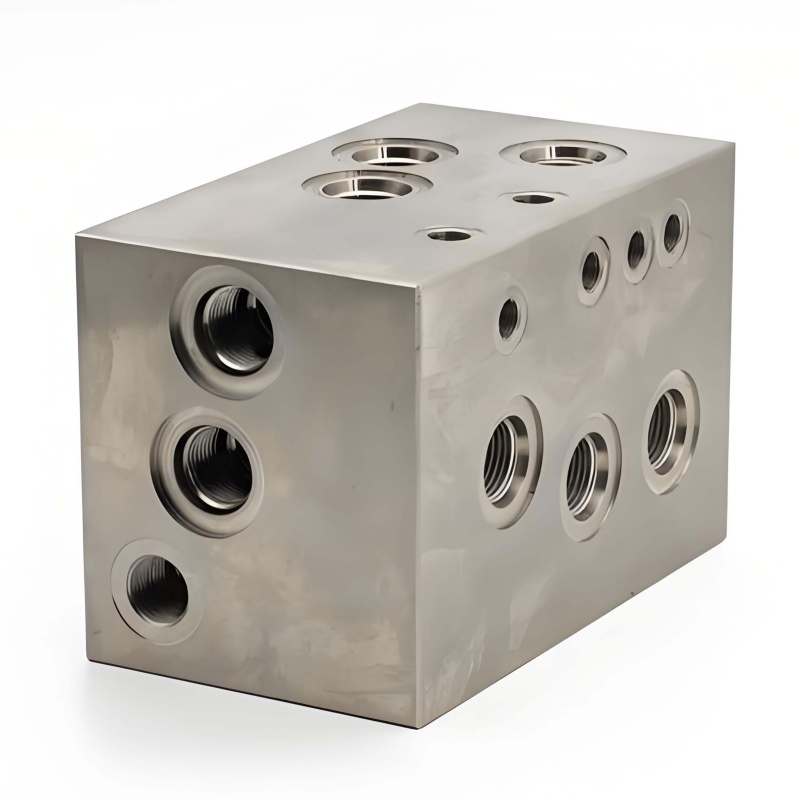
Hydraulic Block
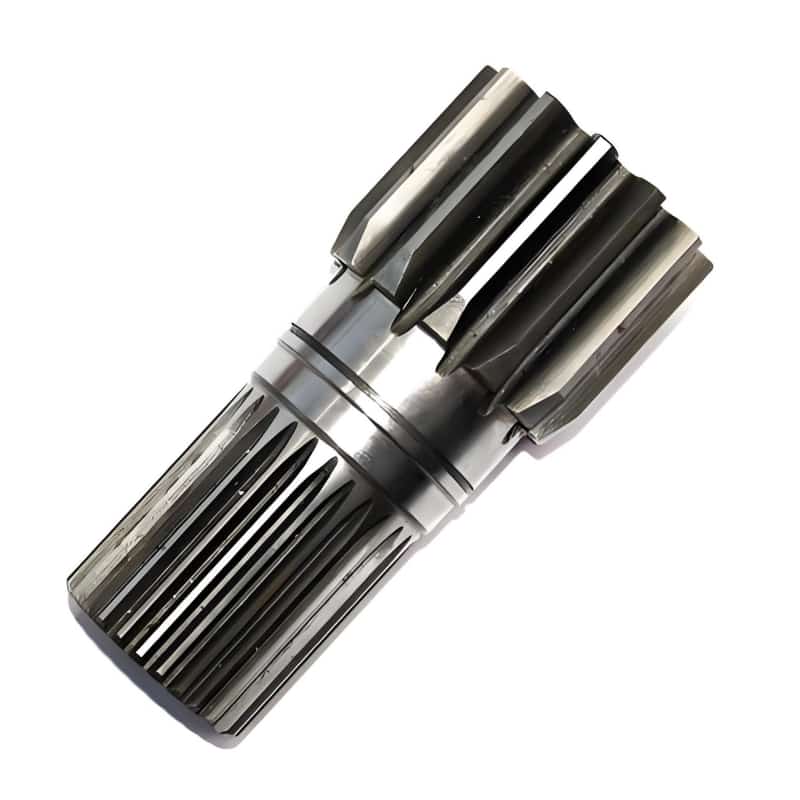
Spline Shaft
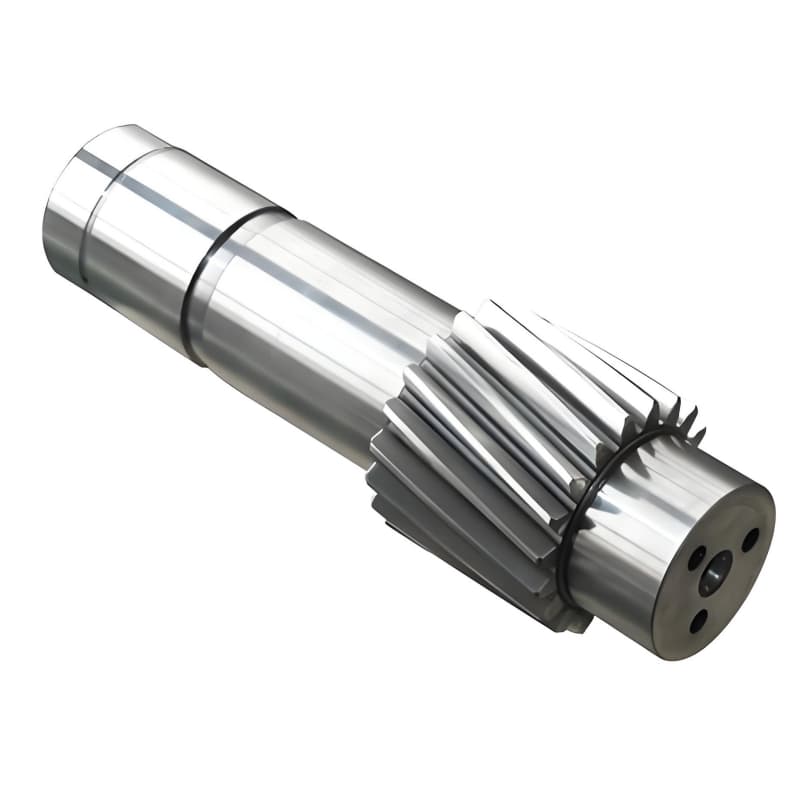
Gear Shaft
Precision & Tolerance Standards
Every 4140 component is manufactured and inspected against defined geometric and dimensional tolerances to ensure interchangeability and reliable assembly.
Dimensional & Geometric Control
- General dimensional tolerance held to IT7 to IT8 per ISO 2768-mK for non-specified features.
- Precision features such as bearing journals and sealing diameters held to IT5 to IT6 with cylindrical grinding.
- Position, concentricity, and circular runout controlled to 0.01 to 0.03 mm per ISO 1101 using in-process gauging.
- Squareness and parallelism maintained within 0.02 mm per 100 mm on machined reference surfaces.
Surface & Thread Quality
- Standard as-machined surface finish Ra 1.6 to 3.2 micrometer on turned and milled surfaces.
- Ground surface finish Ra 0.4 to 0.8 micrometer; polished surfaces down to Ra 0.2 micrometer on request.
- Metric threads 4H and 6H, unified threads 2B and 3B, verified with calibrated thread ring and plug gauges.
- Involute splines produced to ISO 4120 and ANSI B92.1 with class 5 to 7 fit, inspected over pin measurement.
Manufacturing Advantages
Our integrated production model combines material sourcing, machining, heat treatment, and finishing under one roof to deliver consistent quality for custom CNC machining alloy steel 4140 parts in China.
Material Traceability
Every batch of 4140 steel is received with mill test reports documenting chemical composition and mechanical properties. Material heat numbers are recorded and tracked through each production step, ensuring full traceability from raw bar to finished component.
In-House Heat Treatment
Controlled-atmosphere furnaces and induction hardening equipment allow complete process integration. This reduces lead time, eliminates transport damage, and ensures consistent hardness profiles verified with calibrated hardness testers on every heat-treatment batch.
Flexible Production Volume
From single-piece prototypes and small-batch runs of 5 to 50 pieces to series production of several thousand units per month, our production planning adapts to your project scale, delivery schedule, and inventory requirements.
Engineering Support
Our manufacturing engineers review customer drawings for manufacturability, recommend optimal machining sequences, and suggest material and heat-treatment improvements before production begins, reducing costly revisions and improving part performance.
Reliable 4140 Alloy Steel Manufacturing
From material selection and heat treatment to precision CNC machining and surface finishing, every step of production is managed in-house to ensure quality, consistency, and on-time delivery. Our engineering team and production floor are dedicated to manufacturing high-quality custom CNC machining alloy steel 4140 parts in China for industrial customers around the world.