
Custom precision CNC machining stainless steel 304 parts in China
From prototype runs to high-volume production, we deliver tight-tolerance 304 stainless steel components machined on 3-axis, 4-axis, and 5-axis CNC centers. One-stop capability covering milling, turning, drilling, tapping, and surface finishing for custom CNC machining aluminum stainless steel 304 parts in China and global markets.
Precision 304 stainless steel machining for demanding applications
304 stainless steel is the most widely used austenitic grade in precision machining, valued for its balanced corrosion resistance, formability, and mechanical strength. As a China-based machining partner, we convert your 2D drawings and 3D models into finished components with repeatable accuracy across every batch.
Our engineering team reviews every design for machinability before a single chip is cut. We identify potential chatter zones, recommend lead-in radii, and optimize tool paths so that thin walls, deep pockets, and fine threads hold tolerance without deflection.
Whether you need a single prototype for fit-check or 50,000 production parts for an assembly line, the same quality discipline applies. Every workpiece is inspected at key stages, and dimensional reports accompany shipments when required.
Beyond stainless steel 304, our shop regularly machines aluminum 6061 and 7075, brass, copper, carbon steel, alloy steel, and engineering plastics. This material breadth makes us a single source for custom CNC machining aluminum stainless steel 304 parts in China.
304 stainless steel equivalents across global standards
The same austenitic stainless steel is known by different designations depending on the issuing standard. The table below maps the most commonly referenced grades, so your drawing callouts and our material certificates align regardless of the specification system your project follows.
| Standard | Country / Region | Grade Designation | Material Number / Notes |
|---|---|---|---|
| AISI / ASTM | United States | 304 | UNS S30400 |
| EN 10088 | Europe | X5CrNi18-10 | 1.4301 |
| JIS G4303 | Japan | SUS304 | Equivalent to AISI 304 |
| GB/T 1220 | China | 06Cr19Ni10 | Formerly 0Cr18Ni9 |
| ISO 4954 | International | X5CrNi18-10 | Aligned with EN 1.4301 |
| DIN 17440 | Germany | X5CrNi18-10 | 1.4301 |
| BS 970 | United Kingdom | 304S31 | Equivalent grade |
| AFNOR NF | France | Z6CN18-09 | Equivalent grade |
Note: 304L (low carbon, max 0.03% C) and 304H (higher carbon, 0.04-0.10% C) are derivative grades. If your drawing specifies 304L or 304H, please indicate it at the inquiry stage so we source the correct certified bar stock or sheet.
Typical chemical composition and mechanical properties
Chemical composition (wt. %)
| Carbon (C) | max 0.08 |
| Silicon (Si) | max 1.00 |
| Manganese (Mn) | max 2.00 |
| Phosphorus (P) | max 0.045 |
| Sulfur (S) | max 0.030 |
| Chromium (Cr) | 18.00 - 20.00 |
| Nickel (Ni) | 8.00 - 10.50 |
| Iron (Fe) | balance |
Mechanical properties (annealed)
| Tensile strength | min 515 MPa |
| Yield strength (0.2% offset) | min 205 MPa |
| Elongation at break | min 40 % |
| Hardness (HRB) | max 92 |
| Hardness (HB) | max 201 |
| Density | 7.93 g/cm3 |
| Melting range | 1400 - 1450 C |
| Thermal conductivity | 16.2 W/m-K at 100 C |
CNC machining capabilities for 304 stainless steel
Our shop floor combines vertical machining centers, horizontal lathes with live tooling, and secondary finishing equipment to complete parts in as few setups as possible. Fewer setups mean less stack-up error and shorter lead times for every custom CNC machining aluminum stainless steel 304 parts in China project.
3-axis milling
Vertical machining centers with up to 1200 x 600 mm travel handle plates, brackets, housings, and enclosures. Rigid tapping and through coolant keep 304 chips flowing without built-up edge.
4-axis milling
Rotary indexers allow multi-side machining in one clamping, ideal for cross-drilled manifolds, cam-like profiles, and parts requiring features on angled planes.
5-axis milling
Simultaneous 5-axis capability produces complex contoured surfaces, impeller blades, turbine components, and deep cavities that would otherwise need multiple fixtures.
CNC turning
Slant-bed lathes with bar feeders turn shafts, sleeves, connectors, and threaded fittings up to 300 mm diameter. Live tooling adds cross-holes and flats without secondary ops.
Swiss-type turning
Sliding-head lathes produce long, slender parts with high length-to diameter ratios. Guide-bush support maintains concentricity on thin shafts and precision pins.
Threading & tapping
Unified (UNC/UNF), metric (M), NPT, BSP, and custom thread forms are cut or rolled. Thread gauges verify pitch diameter on every critical feature.
Wire EDM
For sharp internal corners, thin slots, and hardened tool steel inserts, wire EDM delivers geometry that conventional cutters cannot reach, with finishes down to Ra 0.4.
Surface finishing
Vibratory deburring, electropolishing, passivation, sand blasting, and polishing are available in-house or through vetted partner shops, all coordinated under one roof.
Industries and applications we serve
304 stainless steel appears wherever corrosion resistance, cleanability, and moderate strength are required together. The sectors below represent the bulk of our recurring production work.
Food & beverage
Sanitary fittings, valve bodies, pump housings, mixer shafts, and conveyor components that withstand frequent wash-down and mild acidic or alkaline environments.
Medical & dental
Instrument handles, surgical tooling components, sterilization tray parts, and dental lab fixtures requiring smooth, non-porous surfaces.
Marine & offshore
Cleats, brackets, fasteners, and pump components exposed to salt-laden air and splash zones where 304 provides a cost-effective corrosion barrier.
Automotive
Exhaust hangers, sensor housings, fuel system components, and custom billet parts for motorsport and aftermarket performance programs.
Industrial equipment
Hydraulic manifolds, pneumatic valve bodies, gear blanks, coupling halves, and structural brackets for OEM machinery builders.
Architecture & construction
Handrail fittings, glass clamps, door hardware, and facade fasteners where visible surfaces must stay bright and rust-free for years.
Representative machined products
The following parts illustrate the range of geometries and feature types we regularly produce from 304 stainless steel bar stock and plate.
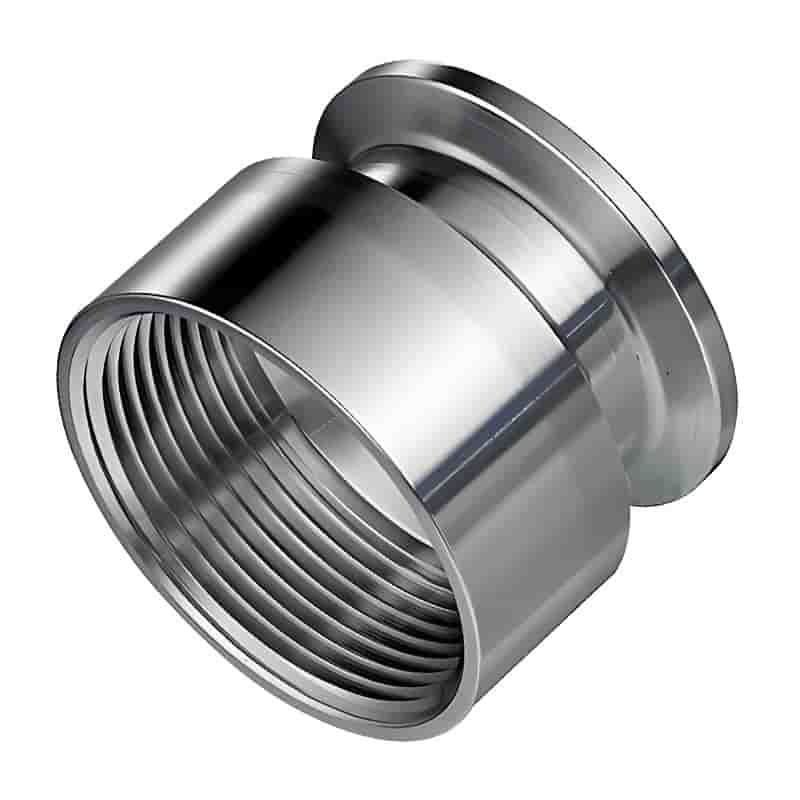
NPT thread quick connector
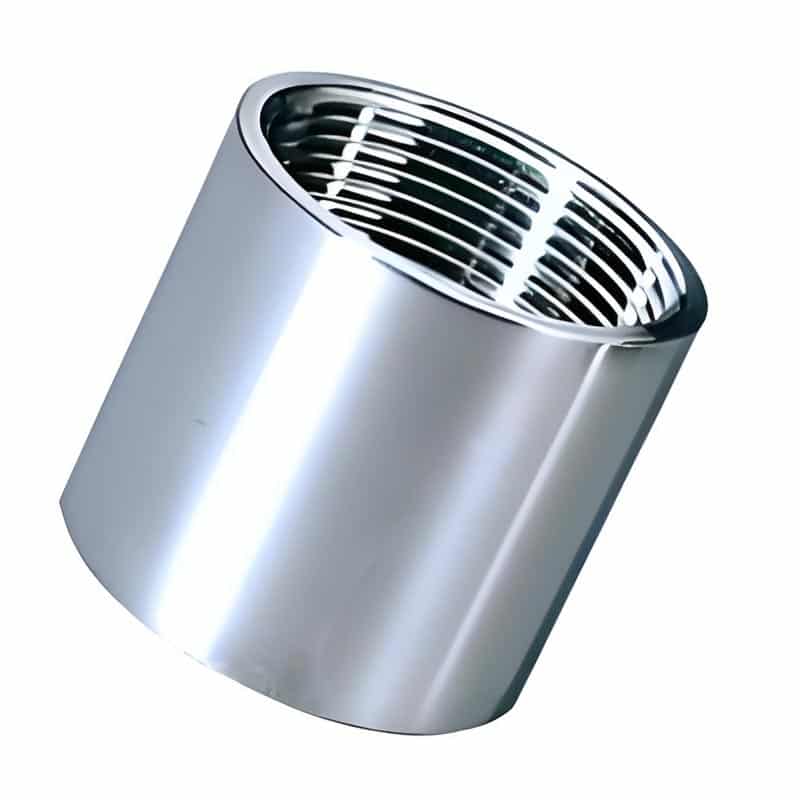
Pipe fitting
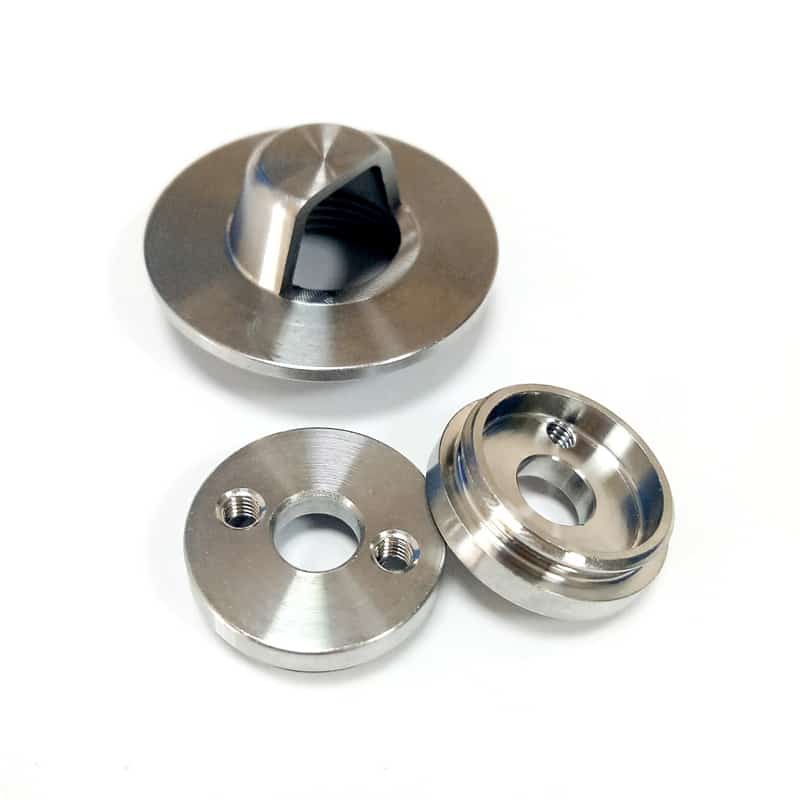
Assembly
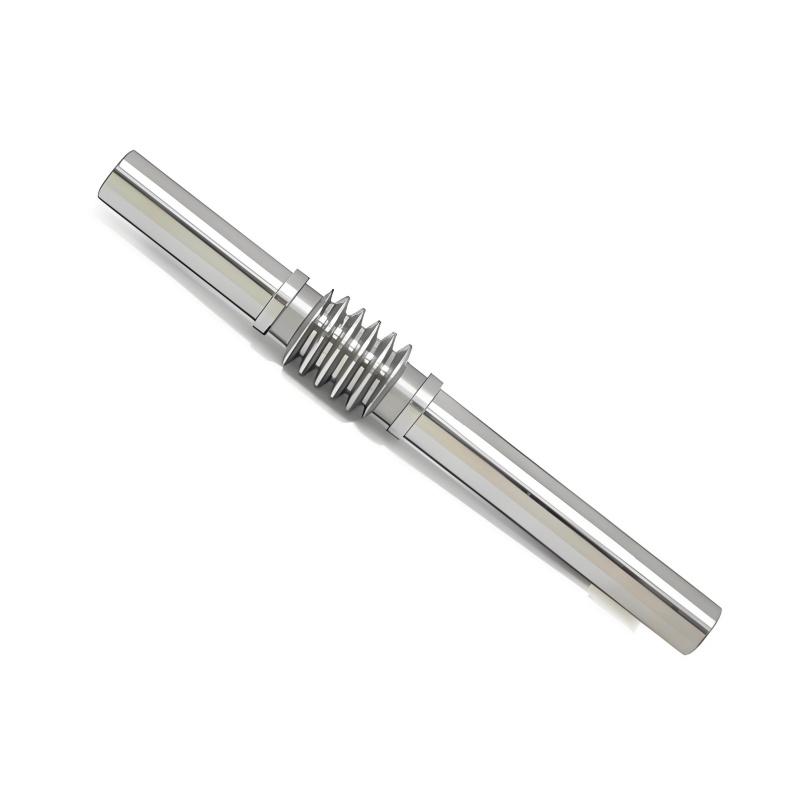
Shaft
Why buyers choose us for 304 stainless steel parts
Material traceability
Every batch of 304 bar or plate is received with a mill test report. We record heat numbers against work orders so material origin can be traced from finished part back to the melt.
In-process inspection
Operators check critical dimensions at first-article, mid-run, and final stages using calibrated micrometers, calipers, height gauges, and CMM where tolerances demand it.
Design for manufacturability
Before production, our engineers flag thin-wall risks, deep-pocket tool access, thread relief needs, and surface finish constraints, then suggest revisions that lower cost without changing function.
Flexible order quantities
One-off prototypes, bridge runs of 50 to 500, and full production of tens of thousands are all handled on the same quality system. No minimum order size is imposed for standard geometries.
Multi-material capability
If your assembly pairs 304 stainless with aluminum 6061/7075, brass, or PEEK, we machine all materials in-house so sub-assemblies arrive matched and ready to fit.
Transparent communication
You receive design feedback, production progress updates, and inspection results in writing. Questions are answered by the engineer assigned to your job, not a generic sales desk.
Tolerance capabilities and surface finish options
Standard and precision tolerances
| General linear tolerance | ±0.05 mm |
| Close tolerance milling | ±0.01 mm |
| Precision grinding / lapping | ±0.005 mm |
| Diameter tolerance (turning) | ±0.01 mm |
| Hole position (CNC) | ±0.02 mm |
| Thread class | 2A / 2B standard, 3A / 3B on request |
| Concentricity | 0.01 mm TIR |
| Flatness | 0.02 mm over 100 mm |
Surface finish options
| As-machined | Ra 1.6 - 3.2 um |
| Fine machined | Ra 0.8 um |
| Polished | Ra 0.2 - 0.4 um |
| Mirror polished | Ra 0.05 - 0.1 um |
| Bead blasted | Uniform matte, Ra 1.6 - 3.2 um |
| Electropolished | Ra 0.2 - 0.4 um, enhanced corrosion resistance |
| Passivated | Citric or nitric acid, removes free iron |
| Brushed / satin | Directional grain, Ra 0.4 - 0.8 um |
Materials we machine beyond 304 stainless steel
While 304 is our most-requested stainless grade, our tooling and fixturing are set up for a broad material range. This is especially useful when your project calls for custom CNC machining aluminum stainless steel 304 parts in China within the same assembly.
Stainless steel 316 / 316L
Higher molybdenum content for improved pitting resistance in chloride environments. Used for marine hardware, chemical processing, and pharmaceutical equipment.
Aluminum 6061-T6
General-purpose structural aluminum with excellent machinability. Anodize-ready for cosmetic and corrosion-resistant finishes on brackets, panels, and enclosures.
Aluminum 7075-T6
High-strength aerospace-grade aluminum for load-bearing components where weight savings matter. Requires sharp tooling and controlled feeds to avoid built-up edge.
Brass C36000
Free-machining brass for connectors, valve stems, and electrical terminals. Produces fine surface finishes with minimal tool wear.
Carbon steel 1045
Medium-carbon steel for shafts, gears, and fixtures. Can be supplied as-machined, black-oxide coated, or heat-treated to specified hardness.
Alloy steel 42CrMo4
Chromium-molybdenum steel for high-stress mechanical components. Quench and temper capability yields tensile strengths above 1000 MPa after machining.
How a typical custom machining project progresses
Inquiry & design review
Send drawings (PDF, DWG, STEP, or IGES) and quantity. We review geometry, tolerances, and material, then return a quotation with lead time and any DFM suggestions.
Material preparation
Certified 304 bar or plate is cut to blank size. Heat numbers are logged, and material is staged with the work order routing sheet.
Machining
Programs are loaded, first-article parts are inspected and approved, then the full run proceeds with in-process dimensional checks at scheduled intervals.
Finishing & deburring
Parts are deburred, cleaned, and sent for any specified surface treatment such as passivation, electropolishing, or bead blasting.
Final inspection
A dimensional report is generated against the drawing. Critical features are 100% checked; general features are sampled per an agreed AQL level.
Packing & shipping
Parts are individually wrapped or compartmentalized to prevent surface damage. Inspection reports and material certificates are enclosed with the shipment.
Frequently asked questions
What file formats do you accept for quotes?
We accept STEP, IGES, XT, DWG, DXF, and PDF drawings. A 3D model plus a 2D drawing with tolerances and surface finish callouts gives the most accurate quotation. If you only have a sketch or sample part, we can work from that as well.
What is the typical lead time?
Prototype quantities of 1 to 10 parts typically ship in 3 to 7 working days. Production runs of 100 to 1000 parts generally take 10 to 20 working days. Larger orders or parts requiring special surface treatments may need additional time, which is stated upfront in the quotation.
Can you machine parts from customer-supplied material?
Yes. If you provide 304 stainless steel bar or plate, we can machine it on a labor-only basis. We require material certification or a sample for verification before cutting, and any material shortage or defect is reported before production begins.
Do you offer assembly or kitting services?
We can assemble sub-components, install threaded inserts or pins, and kit multiple part numbers into labeled compartments. This is useful when you need a ready-to-install module rather than loose individual parts.
Your reliable partner for custom CNC machining aluminum stainless steel 304 parts in China
From a single 304 stainless steel connector to a full production run of precision shafts and fittings, we combine engineering rigor, modern CNC equipment, and transparent project communication to deliver parts that print every time. Send your drawings and let us show you the difference that a focused, experienced machining shop can make on your next project.